Quick Answer
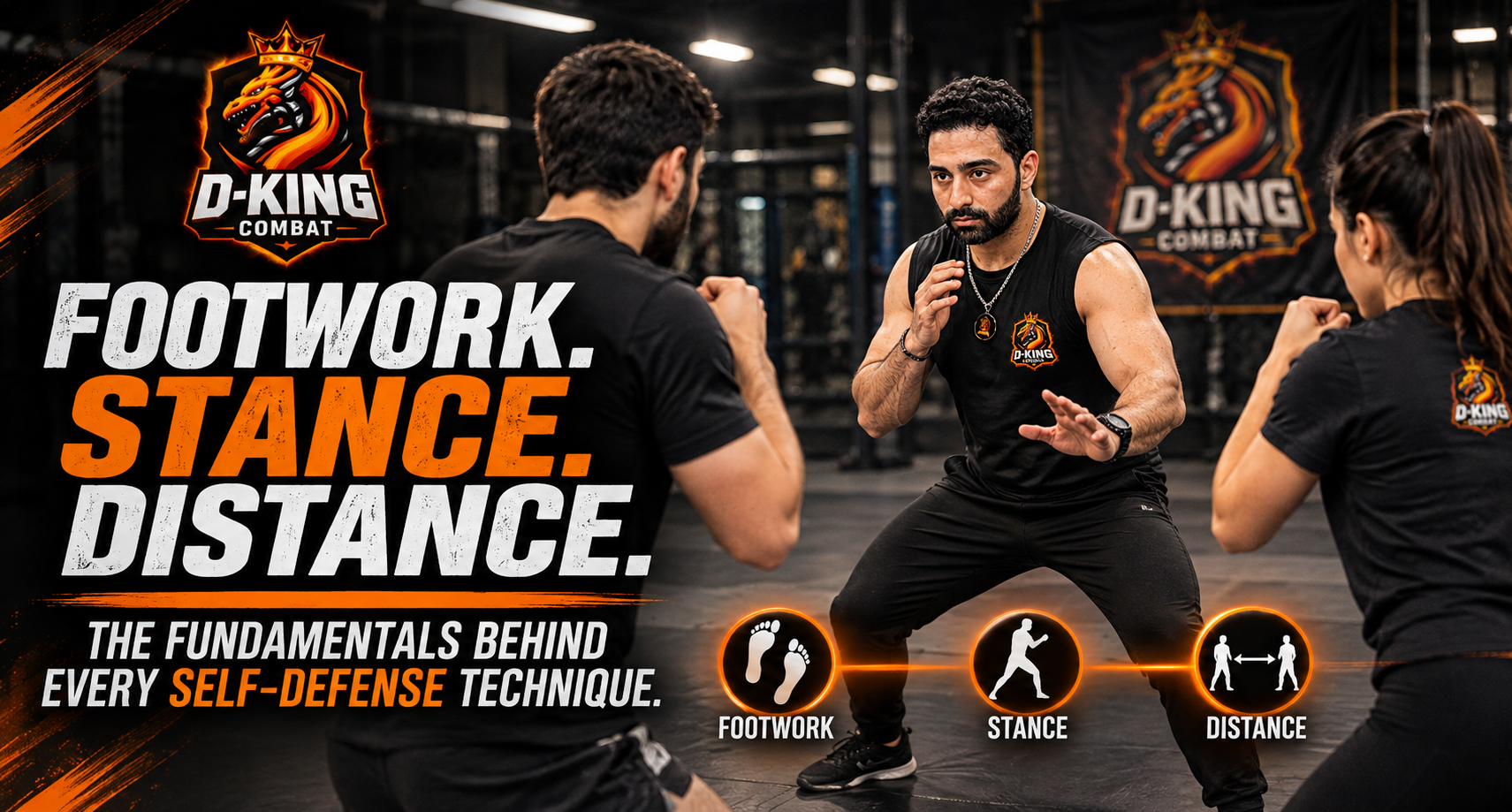
Before any strike, escape or block works, three basics have to be in place: a stable stance (so you cannot be easily pushed or pulled off balance), footwork (so you can move, turn and leave without losing that balance) and distance (so you are far enough away to react, or close enough to act when you choose). Good stance and footwork are less dramatic than techniques, but they make every technique work better, and they are the first things a coach will correct. This is general educational information and is best learned with a qualified instructor and a training partner.
Why the basics matter more than techniques
Many beginners look for a technique for each situation. In practice, techniques fail most often because of the basics under them: someone is off balance, too close, too far, or frozen in place. A simple technique from a stable position works better than an advanced one from a poor position. Our article on why techniques fail under stress explains how pressure strips away anything that was not drilled until it was automatic. Stance, footwork and distance are exactly what you want to be automatic.
Part 1: Stance
A stance is the position you stand in so you can move, defend and act quickly. The details differ by discipline, but the principles are shared.
Principles of a good stance
- Balanced. Feet roughly shoulder-width apart, with one foot slightly forward, weight spread evenly or slightly forward.
- Knees slightly bent. Soft knees absorb force and let you move in any direction.
- Heels light, ready to move. You should be able to step without shifting your whole weight first.
- Hands up and active. Hands are in front of your face and chest, ready to protect or push, not hanging at your sides.
- Chin tucked, eyes up. Protect your jaw and neck, and keep your head still and looking at the person, not at the floor.
- Relaxed shoulders. Tension slows you down and burns energy.
Common stance mistakes
- Feet too close together, which makes you easy to push over.
- Feet too wide, which slows you down.
- Standing flat and stiff.
- Leaning back, which puts your weight on your heels.
- Hands dropping when you move.
Part 2: Footwork
Footwork is how you move while staying balanced. It lets you leave, turn, create space or close in.
The basic rules
- Step, do not cross. Move the foot closest to the direction you are going first, and follow with the other. Crossing your feet makes you easy to unbalance.
- Keep your feet apart as you move. Small steps keep your base wide.
- Stay on the balls of your feet, light and ready.
- Move your head and body together, not just your arms.
- Pivot to turn. Rotating on the ball of one foot lets you change direction quickly.
Core movements worth practising
- Step forward and back.
- Step side to side.
- Pivot (turn) to face a new direction.
- Angle step: stepping off the direct line of an advance instead of straight back.
Why not just backpedal? Walking backwards in a straight line is slow and puts you on your heels. Moving at an angle or turning to leave is usually faster and safer. If you can safely leave, turning and moving away toward people and light is generally better than staying to fight. See our guide to situational awareness and how to de-escalate a confrontation.
Part 3: Distance
Distance (also called range) is how far you are from another person. Coaches often describe three zones.
1. Out of range. Too far for either person to reach the other with a hand or foot. This is the safest zone and the best place to talk, de-escalate or leave.
2. Striking or reach range. One step makes contact possible. This is where things can start quickly, so being aware here matters.
3. Close range or grabbing distance. Close enough to grab, push, hold or clinch. Many assaults happen here, including pushes, grabs and holds. See our guides to handling a push or shove, escaping a wrist grab and escaping a headlock or bear hug.
Managing distance in practice
- Notice how far away someone is before they speak or move toward you.
- Create space early. If someone approaches in a way that feels wrong, move or turn before they reach you.
- Use your hands as a barrier, open and in front of you, which looks like a calm gesture, not an aggressive one. Coaches often call this a "fence" or an active guard position.
- Do not let someone walk you into a corner or a wall. Keep an exit behind or beside you where possible.
- Never turn your back without a reason, but do not stay rooted if you can leave safely.
How stance, footwork and distance work together
Imagine someone is walking toward you angrily in a car park.
- Distance: you notice early and increase the gap by moving to a safer line, near people or lights.
- Stance: if they keep coming, you settle into a balanced position with your hands up in a calm, open way.
- Footwork: you angle off their direct path rather than backing straight into a wall.
- Decision: you talk, leave, or if you have no choice, act from a stable base.
The skills layer on top of each other. For more on car parks and similar places, see our guide to lift, car park and parking garage safety.
How the basics show up in different disciplines
- Krav Maga: a balanced, practical stance with active hands and the ability to move and strike immediately. See what Krav Maga is and our Krav Maga choke defense guide.
- Boxing: footwork, head movement and distance control are central. See boxing for self-defense.
- Muay Thai: a stable stance that allows kicks, knees and clinch work. See Muay Thai for self-defense.
- Arnis: angling, footwork and distance are fundamental to its weapon and empty-hand systems. See what Arnis is.
- BJJ: stance and posture matter on the ground too, through base, balance and managing distance to the opponent. See BJJ for self-defense.
Simple drills to build the basics
Do these slowly at first. Accuracy matters more than speed.
- Stance check (2 minutes). Stand in front of a mirror, set your feet and hands, and check your balance by gently shifting your weight. Your coach can correct details.
- Step and return. Step forward, back, left and right, and return to your stance each time without crossing your feet.
- Pivot practice. Turn 90 and 180 degrees on the ball of one foot and finish balanced.
- Shadow movement. Move around the room with light, bouncing steps and your hands up.
- Distance drill with a partner. One person steps in and out slowly while the other adjusts their position to stay at a comfortable distance.
- Angle drill. The partner walks in, and you practise stepping off the line instead of straight back.
Warm up first: see our 10-minute mobility routine. Practise with a partner only at a controlled pace, under instruction. Our guide to sparring for beginners shows how to add pressure safely.
Common beginner mistakes
- Skipping the basics to learn "cooler" techniques.
- Standing still or flat-footed.
- Crossing feet when moving.
- Backing straight away in a line.
- Dropping the hands when stepping.
- Staying too close without a plan.
- Practising only fast, never accurate.
How long does it take to build good footwork?
It varies. Most people notice better balance and movement within the first weeks of regular training, but it keeps improving for years, which is why experienced fighters still drill the basics. If you have an injury or limitation, see our guide to training with an injury or physical limitation.
Can you learn this online or at home?
You can build the habit of good posture and light movement at home, but a coach will spot small errors in balance and angle that a video cannot. See our guide to whether you can learn self-defense online.
The legal side in the UAE
You have a right to defend yourself, but force must be necessary and proportionate. Using distance and footwork to leave is the safest and most defensible choice. Read our guide to self-defense laws in the UAE. This is not legal advice; consult a licensed UAE lawyer for specific questions.
Learn the fundamentals at DKing Combat in Dubai
DKing Combat System trains at Max Burn Gym, Al Quoz 3, Dubai, with fundamentals taught from the first session. Training begins with an application. Pricing, schedules and availability are best confirmed with DKing Saad or via the apply page. See also what to expect at your first class.
Frequently Asked Questions
What is the best stance for self-defense?
A balanced, slightly bent-knee stance with one foot forward, hands up, chin tucked and weight ready to move. Exact details vary by discipline and coach.
Why does footwork matter in self-defense?
Footwork keeps you balanced while you move, turn, create space or leave. Without it, even good techniques fail because you are off balance.
What is distance management?
It is controlling how far you are from another person, so you have time to react, talk or leave, and can act effectively if you must.
How far should I stay from someone who seems aggressive?
As far as practical, ideally out of reach. Keep your hands up in an open, calm way and keep an exit available.
Should I back away in a straight line?
Usually not. Angling or turning to leave is faster and keeps you more balanced than walking backwards.
Can beginners learn footwork quickly?
Beginners can see progress in balance and movement within weeks of regular training, and it continues to improve with practice.
What is a fence or active guard position?
It is holding your open hands in front of you, which protects your space and looks non-aggressive, so you can respond quickly if needed.
Can I practise footwork at home?
Yes, basic stance, stepping and pivoting can be practised at home, but a coach is the best way to correct mistakes.
This article is general educational information, not legal advice or a substitute for supervised training. In an emergency in the UAE, call 999.
📍 DKing Combat System, Max Burn Gym, Al Quoz 3, Street 4, Warehouse #10, Dubai, UAE 📞 DKing Saad: +971 50 754 6104 🌐 dkingcombat.com ✅ Apply here: dkingcombat.com/apply
DKing Saad (Saad Iqbal) has coached martial arts and real-world self-defense for more than 20 years and is the founder of the DKing Combat System in Al Quoz, Dubai. More about Saad.