Quick Answer
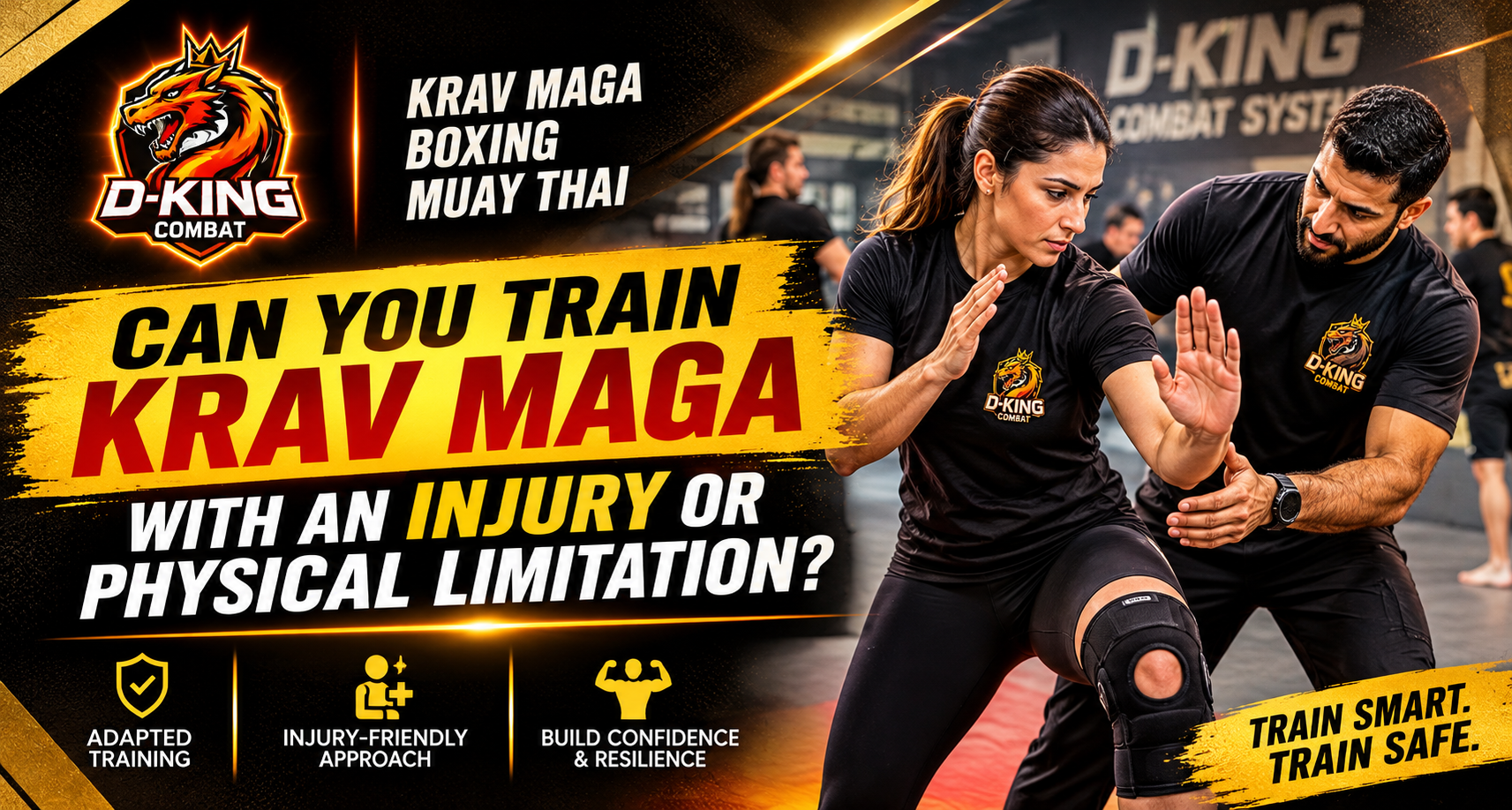
Often, yes, but it depends on the injury, and it should be a conversation, not an assumption. At DKing Combat in Al Quoz, Dubai, programs are adapted to each student's injuries, fitness level, and goals, rather than forcing everyone through the same fixed routine. That said, this is training, not medical treatment, and anyone with an existing injury or medical condition should check with a doctor before starting.
Why this question comes up so often
Almost nobody walks into a combat gym with a perfectly healthy, injury-free body. A tweaked lower back, a knee that never fully recovered, a shoulder with a surgical history, years of desk posture, these are the normal starting points for most adults, especially professionals in their 30s, 40s, and beyond. Many people quietly rule themselves out of training because of one of these, assuming combat training means constant high-impact stress on exactly the parts of their body that already bother them.
That assumption is understandable, and sometimes right. But often it isn't.
What "adapted to you" actually means
Programs at DKing Combat are built around the student, not the other way around. In practice, that means a few specific things:
The starting conversation covers your body, not just your goals. Before any program begins, the assessment includes an honest discussion of injuries, past surgeries, current pain, and fitness level, so training starts from what's true, not from an idealized beginner.
Technique choices change, not the goal. If a particular movement loads a sensitive joint badly, there are usually alternative ways to train the same underlying skill, whether that's a different stance, reduced range of motion, or a different drill that builds the same capability with less stress on the problem area.
Intensity is scaled, not skipped. Sparring, impact work, and high-load conditioning are introduced gradually and matched to what your body can currently tolerate, rather than dropped into on day one regardless of your history.
Progress is measured against you. There are no belts and no competitions at DKing Combat, so there's no pressure to keep pace with someone else's body. That matters more than people expect when you're training around a limitation.
Common situations, and how they're generally approached
Lower back issues. Often the most common concern. Training tends to emphasize core stability, hip mobility, and controlled movement patterns rather than heavy loaded spinal flexion or rotation, scoped to what's comfortable and safe for you.
Knee concerns. Footwork, stance depth, and impact are adjusted, with more emphasis on stability and controlled loading than on explosive, high-impact movement early on.
Shoulder or wrist limitations. Striking and grappling mechanics are modified to reduce load on the affected joint while still building overall capability.
Returning after surgery or a long layoff. Timing depends entirely on medical clearance, which is your doctor's decision, not ours. Once cleared, training can be built back up gradually rather than resuming where you left off.
Real examples from DKing Combat students
Other people have walked in with similar worries. Read their stories: a knee surgery comeback, a retired footballer returning to training, a dentist with three years of daily neck pain and a programmer whose desk posture was wearing him down. Every body is different, so these are individual experiences, not promises of results.
Starting later in life, or from a low fitness base
Age and fitness level are limitations too. If you are 40 or older, see getting fit after 40 in Dubai and self-defense for older adults in Dubai. Before class, a proper warm-up helps every body, so try our 10-minute mobility routine.
Questions worth asking any gym before you join
- Will someone ask about my injuries before I train?
- Can I lower the intensity or sit out a drill without awkwardness?
- Is there a gradual path into sparring? See our guide to sparring for beginners.
- Who is coaching, and what is their background?
For more, see how to choose a self-defense school in Dubai.
Where the coaching background fits in, and where it stops
DKing Saad's coaching is informed by training in kinesiology, sports injury rehabilitation principles, and a regulated Level 4 Strength and Conditioning qualification, which shapes how movement, loading, and progression are approached. Read more about the coach in who is DKing Saad.
But it's important to be clear about the boundary: that background informs how training is coached. It is not medical diagnosis or treatment, and it doesn't replace a doctor or physiotherapist. If you have a diagnosed injury, an unresolved pain problem, or a medical condition, the right first step is medical guidance, and the right second step is a conversation about how training can fit around it.
What to do before you apply
Get medical clearance first if you have a current or recent injury or a diagnosed condition. Bring that information to the assessment honestly, including things that feel embarrassing or minor, since the more accurate the picture, the better training can be adapted. And be realistic that some conditions may mean a slower start, or, occasionally, that certain training isn't appropriate right now. An honest "not yet" is better than pushing through something that sets you back.
How this connects to the wider approach
This is part of the same thinking behind how training is structured across the whole DKing Combat System, including Injury Prevention and Recovery in Combat Training and Strength and Conditioning for Krav Maga, where sustainable, long-term capability matters more than short-term intensity.
Frequently Asked Questions
Can I train Krav Maga with a bad back?
Often, yes, with adaptations. Training is adjusted to emphasize stability and controlled movement rather than heavy spinal loading. Check with your doctor first if your back issue is current or unresolved, and discuss it openly at your assessment.
Is martial arts safe with bad knees?
It depends on the specific issue, but many students with knee concerns train with modified footwork, reduced impact, and gradual loading. Medical guidance comes first, then training is adapted around what your knees can currently handle.
Do I need a doctor's approval before starting?
If you have a current injury, a recent surgery, or a diagnosed medical condition, yes, medical clearance is the right first step. This article is general information and not medical advice.
Will I be pushed to do things my body can't handle?
No. Programs are adapted to your injuries and fitness level, and intensity is scaled to what you can currently tolerate rather than a fixed standard for everyone.
How do I start training if I have an injury or limitation?
Apply through dkingcombat.com/apply or message DKing Saad directly on WhatsApp, and be upfront about your injury history so training can be built around it from the beginning.
This article is general information and not medical advice. If you have an injury or medical condition, consult a qualified doctor before starting any training program.
📍 DKing Combat System, Max Burn Gym, Al Quoz 3, Street 4, Warehouse #10, Dubai, UAE 📞 DKing Saad: +971 50 754 6104 🌐 dkingcombat.com ✅ Apply here: dkingcombat.com/apply
DKing Saad (Saad Iqbal) has coached martial arts and real-world self-defense for more than 20 years and is the founder of the DKing Combat System in Al Quoz, Dubai. More about Saad.