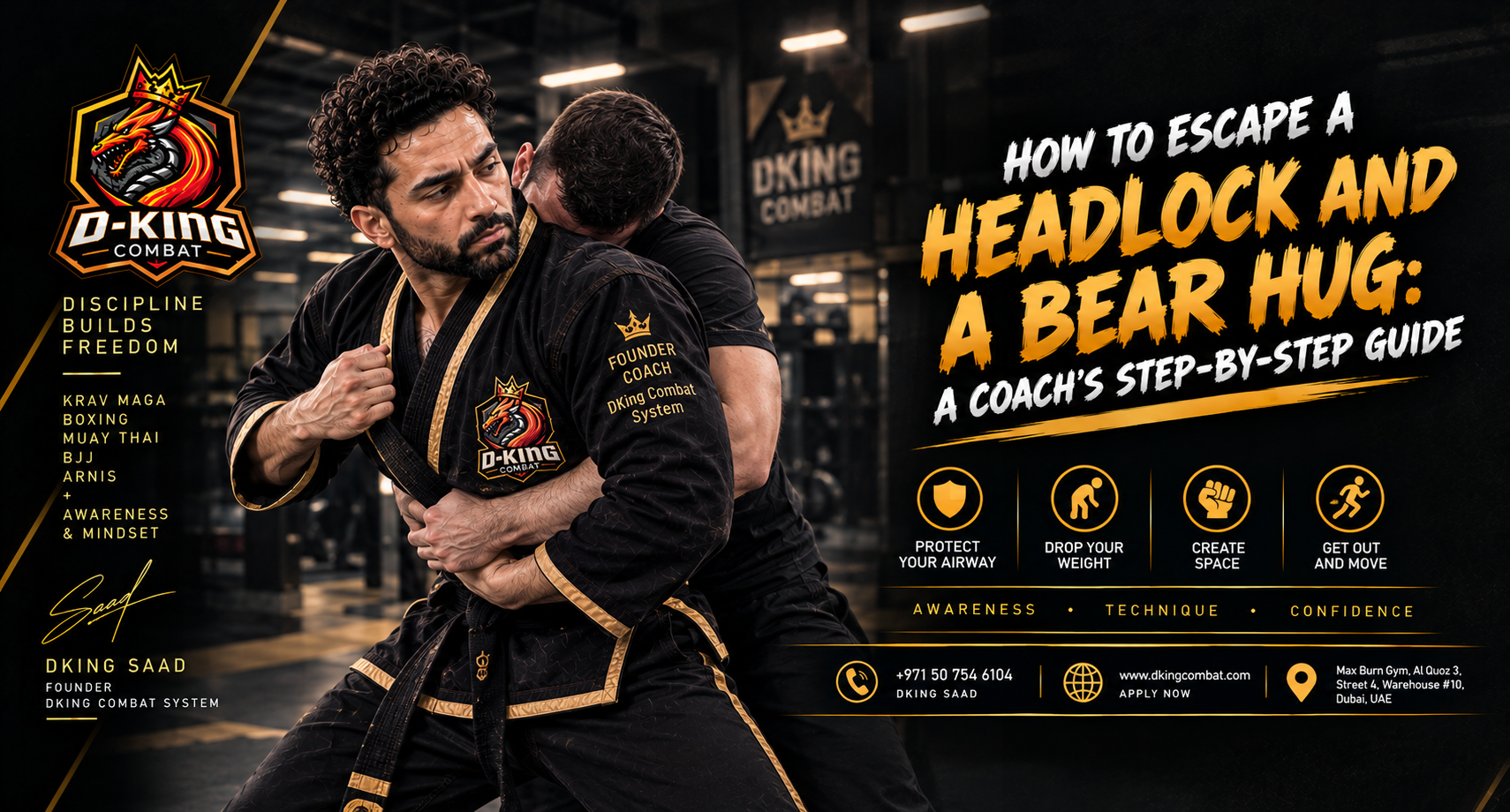
Quick Answer
To escape a headlock or a bear hug, do four things in order: protect your airway and spine, drop your weight and turn to take away the other person's leverage, create space with a simple strike or hip movement, and get out and move away. Strength is not the deciding factor: position, timing and staying calm are. These holds are best learned with a qualified instructor and a cooperative partner, because reading about them is not the same as feeling them. This article is general educational information, not a substitute for supervised training.
Why these holds feel so frightening
A headlock restricts your head and sometimes your breathing. A bear hug pins your arms and lifts or squeezes you. Both create the same reaction: panic, tension and pulling backwards. That instinct usually makes things worse, because it gives the other person a stable base. Our articles on the fight, flight or freeze response and why techniques fail under stress explain why training the first few seconds matters so much.
The four principles that apply to every escape
- Protect first. Tuck your chin, keep your airway clear and keep your spine stable.
- Lower your centre of gravity. Bend your knees and drop your weight. It makes you harder to lift, throw or drag.
- Create space. A short, fast strike or hip movement opens a gap.
- Exit and move. Do not stay to "win." Turn, move away and get to safety.
If you only remember one thing: drop, turn, create space, leave.
Headlock escape (side headlock)
A side headlock wraps an arm around your head, usually from the side or front. The danger is neck pressure and being steered off balance.
Step by step
- Tuck your chin and turn your head toward the attacker's body. This protects your throat and gives you room to breathe.
- Drop your weight with a wide, bent-knee stance. Do not pull away; stay close and low.
- Control the encircling arm. Use your near hand to take hold of the arm or wrist that is wrapped around you, to relieve pressure.
- Create space with a short, direct strike to a vulnerable area, such as the groin, ribs or thigh, while keeping your head protected.
- Turn your body and shoulders to pull your head out as the grip loosens, keeping your hands up.
- Move away and keep your guard up. Create distance and head for safety or people.
Common mistakes: pulling straight back, which tightens the grip; lifting your head instead of tucking it; freezing instead of acting in the first second.
Rear bear hug (grabbed from behind)
This is one of the most common close-range holds. The danger is being lifted, carried or controlled.
Step by step
- Drop your weight immediately, bending your knees and sitting your hips down and back.
- Keep your elbows wide and your arms active. If your arms are free, widen them to prevent a tight squeeze.
- Create space with a short strike, such as an elbow, a stamp to the instep, or a head or hand strike to a vulnerable area. Aim to open the grip, not to fight.
- Turn your hips and shoulders as soon as the squeeze loosens, to face the attacker or slip out to one side.
- Break contact and move away. Do not stay at close range.
Common mistakes: standing tall, which makes lifting easy; trying to pull their hands apart with strength alone; staying in position after the grip loosens.
Front bear hug (face to face)
Step by step
- Drop your weight and widen your base.
- Keep your head back or turned to protect your face and keep your arms close to your body to avoid being pinned.
- Create space with short strikes to vulnerable areas, or push against the hips or chin to open a gap.
- Turn and step out to the side as the hold loosens.
- Move away and keep your hands up.
What if your arms are pinned?
This is a common worry. The principles stay the same: lower your weight, keep movement small and quick, and use whatever is free: a knee, a foot stamp, a head movement or a hip turn, to open a gap. Training this with a partner teaches you what is possible.
Why strength is not the deciding factor
These holds work by using leverage, weight and surprise. Escapes work by taking those away. A smaller person who drops their weight, stays calm and moves first can often get out of a hold that a larger, tense person cannot. That is why the same principles apply to everyone. For more on this idea, see our guide to women's self-defense in Dubai.
Headlock versus choke: what is the difference?
A headlock controls your head and neck from the side or front. A choke targets your airway or blood flow. They can overlap, and either can become dangerous quickly. For the choke-specific fundamentals, read our guide to Krav Maga choke defense.
How to practise safely
- Learn with a qualified instructor. Holds are risky to practise badly.
- Use a cooperative partner and start slowly. Agree on a stop or tap signal.
- Build intensity gradually, and never practise on the neck or airway at speed or with force.
- Drill the first second: the drop, the tuck and the turn.
- Add stress slowly. Our article on sparring for beginners covers how to progress safely.
The legal side in the UAE
You have a right to defend yourself, but force must be necessary and proportionate, and it has to stop once you are free. Escaping and leaving is both the safest and the most defensible option. Our guide to self-defense laws in the UAE explains the basics. This is not legal advice; consult a licensed UAE lawyer for specific questions.
Learn this properly at DKing Combat
Grab, choke and hold defense are core parts of Krav Maga. DKing Combat System teaches them as part of a structured system at Max Burn Gym, Al Quoz 3, Dubai, with a full progression from beginner level. Read our guides on what Krav Maga is, the first 90 days and what to expect at your first class. Training begins with an application. Pricing, schedules and availability are best confirmed with DKing Saad or via the apply page.
Frequently Asked Questions
How do I escape a headlock?
Tuck your chin, drop your weight, control the encircling arm, create space with a short strike, then turn your head out and move away. Do not pull straight back.
How do I escape a bear hug from behind?
Drop your weight at once, keep your elbows wide, create space with a short strike such as an elbow or foot stamp, turn your hips as the grip loosens, and move away.
What if my arms are pinned in a bear hug?
Lower your weight and use whatever is free, such as a knee, foot, head or hip turn, to open a gap, then turn and exit. Practise this with a partner under supervision.
Can a smaller person escape a bigger person's hold?
Yes. Escapes rely on position, leverage and timing more than strength. Dropping weight and moving first often beats tension.
What is the difference between a headlock and a choke?
A headlock controls the head and neck; a choke targets the airway or blood flow. Both can be dangerous and can overlap.
Is it safe to practise headlock escapes at home?
Not on your own or with force. Learn with a qualified instructor and a cooperative partner, at slow speed, with agreed stop signals.
Does Krav Maga teach headlock and bear hug defense?
Grab, choke and hold defense are core parts of Krav Maga. Ask any school how they teach them and how they keep training safe.
Is escaping and leaving legally safer than fighting back?
Escaping is both the safest and generally the most defensible option, because the law expects force to be necessary and proportionate and to stop when the threat ends. Consult a licensed lawyer for specific questions.
This article is general educational information, not a substitute for supervised training, medical advice or legal advice. In an emergency in the UAE, call 999.
📍 DKing Combat System, Max Burn Gym, Al Quoz 3, Street 4, Warehouse #10, Dubai, UAE 📞 DKing Saad: +971 50 754 6104 🌐 dkingcombat.com ✅ Apply here: dkingcombat.com/apply
DKing Saad (Saad Iqbal) has coached martial arts and real-world self-defense for more than 20 years and is the founder of the DKing Combat System in Al Quoz, Dubai. More about Saad.