Quick Answer
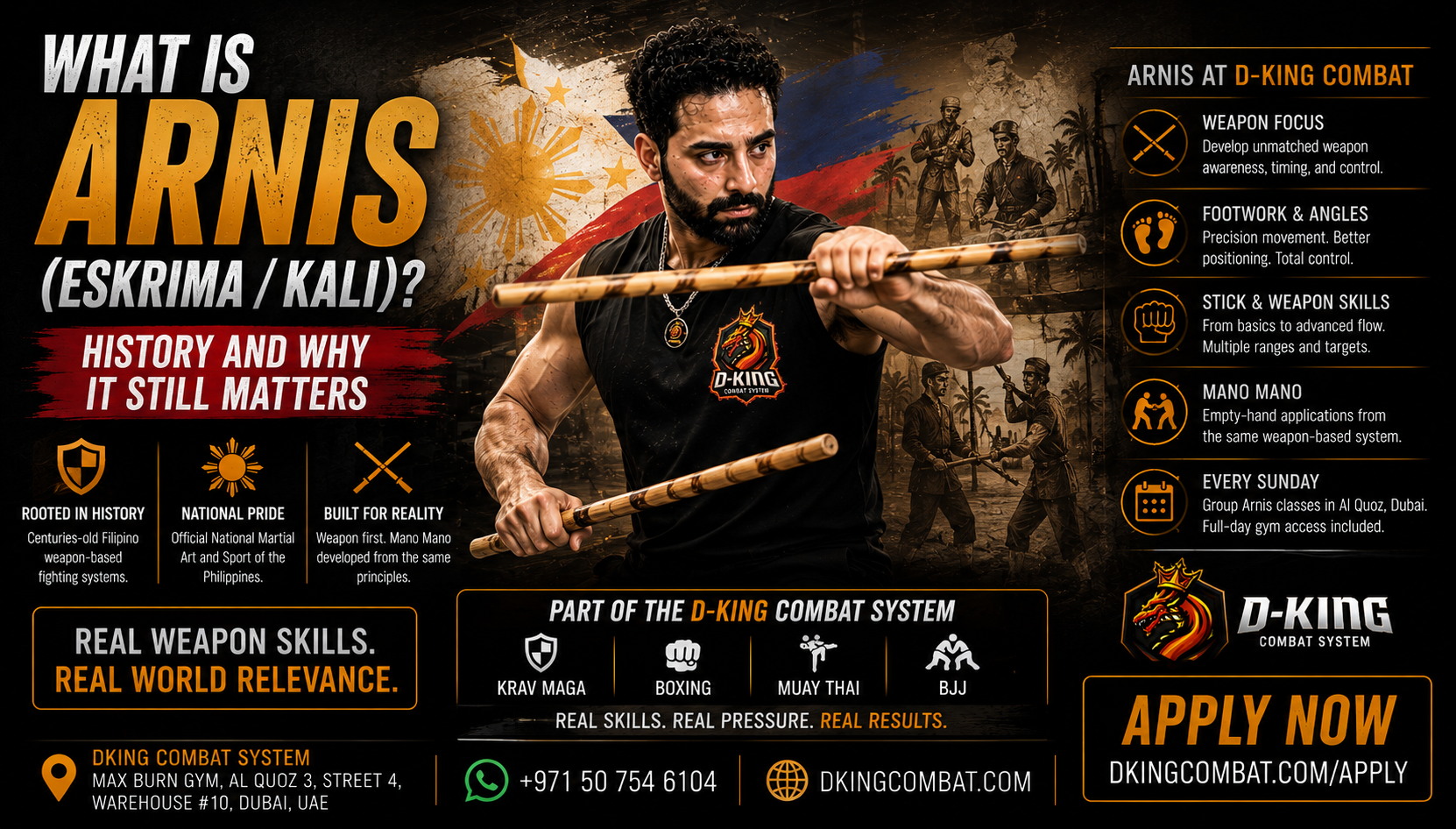
Arnis, also known as Eskrima or Kali, is the official national martial art and sport of the Philippines, recognised under Republic Act No. 9850. Its roots trace back centuries to indigenous Filipino weapon-based fighting systems, later shaped by resistance against colonial forces. Today it remains genuinely relevant, not as a historical relic, but as one of the few martial arts built specifically around weapon awareness, a gap most modern combat training still leaves open. At DKing Combat in Al Quoz, Dubai, Arnis is taught as part of the full combat system, with group classes running every Sunday.
Where Arnis actually comes from
Long before Arnis had a name recognised internationally, indigenous Filipino communities were developing weapon-based fighting methods suited to their environment, terrain, and available materials, most notably rattan sticks, given the practical realities of island life and frequent local conflict. These systems were functional first, built for real survival, not formalised sport.
The name "Arnis" itself is believed to derive from the Spanish "arnes," referring to armor, a legacy of the centuries of Spanish colonial presence in the Philippines. During this period, practitioners preserved and adapted their fighting systems partly by disguising them within cultural dances and performances, a way of keeping the knowledge alive under restriction. That history matters, this isn't a martial art invented recently for commercial appeal. It survived because it was actively hidden and protected across generations.
From survival system to national identity
Over time, Arnis, Eskrima, and Kali (regional naming variations of largely the same family of systems) became deeply woven into Filipino cultural identity. Recognition of its national significance was formalised relatively recently, Arnis was declared the official national martial art and sport of the Philippines under Republic Act No. 9850 in 2009, a rare example of a country formally codifying a traditional fighting system as part of its national heritage.
What makes Arnis genuinely different from most martial arts
Most combat systems, ancient or modern, developed around empty-hand combat first, with weapons treated as an advanced or secondary addition. Arnis developed the opposite way, weapon skill came first, and empty-hand technique (Mano Mano) developed as an extension of the same principles, footwork, timing, and angles, applied without a weapon in hand.
This ordering matters practically. A practitioner trained in Arnis develops a level of weapon awareness, timing, and spatial control that's difficult to replicate starting from a purely empty-hand background. That's a genuinely rare skill set in most modern martial arts training.
Why this history matters for self-defense today
Most self-defense systems taught today focus heavily on empty-hand scenarios and treat weapon defense as an afterthought, a few isolated techniques bolted onto a broader curriculum. Arnis inverts that gap entirely, weapon awareness isn't an add-on, it's the foundation the entire system was built from.
This is exactly why Arnis holds a place inside the full combat system at DKing Combat, alongside Krav Maga, Boxing, Muay Thai, and BJJ. Real confrontations can involve improvised or actual weapons, and a system with centuries of specifically weapon-focused development fills a gap that most modern combat training leaves genuinely open.
Training Arnis today
Arnis training at DKing Combat in Al Quoz, Dubai, is taught with respect for this history and lineage, not as a simplified or invented version disconnected from its roots. Classes cover stick and weapon handling, footwork, timing, and empty-hand applications drawn from the same principles the system was built on. Group Arnis classes run every Sunday, with full-day access to Max Burn Gym included. You can see full class details, pricing, and schedule on our Arnis Classes in Dubai page.
Frequently Asked Questions
What is the difference between Arnis, Eskrima, and Kali?
They refer to the same family of Filipino Martial Arts, with naming differences largely regional across the Philippines. Arnis is the term formally recognised in Republic Act No. 9850 as the national martial art and sport.
How old is Arnis as a martial art?
Its roots trace back centuries to indigenous Filipino weapon-based fighting systems, later shaped and adapted during the Spanish colonial period, making it one of the older continuously practiced martial arts traditions in Southeast Asia.
Why does Arnis train weapons before empty-hand technique?
Unlike most martial arts that developed empty-hand combat first, Arnis originated as a weapon-based system, with empty-hand technique developing later as an extension of the same footwork, timing, and angular principles.
Is Arnis still relevant for modern self-defense?
Yes, arguably more than ever. Most modern self-defense systems treat weapon defense as a minor addition. Arnis's entire foundation is weapon awareness, filling a genuine gap in most contemporary combat training.
Where can I learn authentic Arnis in Dubai?
DKing Combat teaches Arnis as part of its full combat system in Al Quoz, Dubai. See Arnis Classes in Dubai for class details, or apply through dkingcombat.com/apply.
📍 DKing Combat System, Max Burn Gym, Al Quoz 3, Street 4, Warehouse #10, Dubai, UAE 📞 +971 50 754 6104 🌐 dkingcombat.com ✅ Apply here: dkingcombat.com/apply
DKing Saad (Saad Iqbal) has coached martial arts and real-world self-defense for more than 20 years and is the founder of the DKing Combat System in Al Quoz, Dubai. More about Saad.