Quick Answer
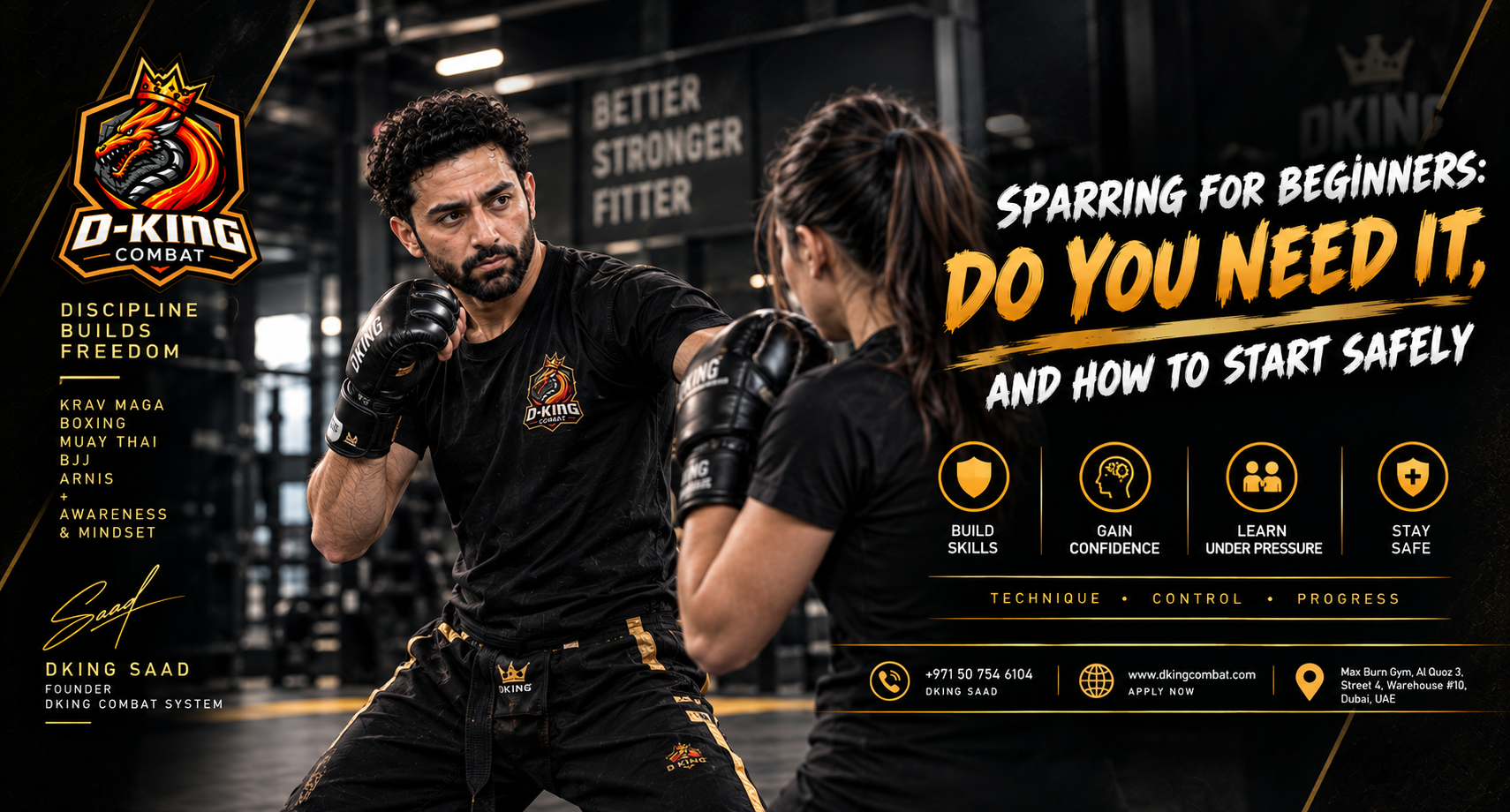
Sparring is controlled, live practice against a partner who resists. For self-defense, it is the best way to test whether technique works under pressure, but beginners should not start with hard contact. A good progression moves from drills to light, technical, partner-agreed sparring, with coach supervision, proper gear and clear rules. You do not need to spar on day one, and you should not be pushed into it. If a school throws new students into hard sparring with no build-up, treat that as a red flag. This is general information, not medical advice.
What sparring actually is (and isn't)
Sparring is not a fight. It is a training exercise where two people apply skills against live resistance, at an agreed intensity, with the goal of learning rather than winning.
It is different from:
- Drilling: repeating a technique with a cooperative partner.
- Pad work: striking a target held by a coach or partner.
- Fighting: an unstructured situation with no shared rules or safety.
Skills that feel automatic in a drill often fall apart when someone moves, resists or surprises you. Sparring is where you find that out safely. Our article on why techniques fail under stress explains the gap in more detail.
Is sparring necessary for self-defense?
It is not strictly required, but it is highly valuable. Reasons it helps:
- It tests your skills against resistance instead of a partner who stands still.
- It builds timing and distance control, which you cannot learn from drills alone.
- It teaches you to stay calm while being pressured, a skill covered in our guide to the fight, flight or freeze response.
- It exposes gaps in your game so your coach can fix them.
That said, sparring is a training tool, not the point of self-defense. The real aims are awareness, avoidance and escape. See our guide to situational awareness and our article on self-defense myths for why "winning a fight" is the wrong goal.
When are you ready to start sparring?
There is no fixed date, but a sensible checklist is:
- You can perform the basic stance, footwork and core techniques without thinking hard about each step.
- You understand the safety rules and the tap-out or stop signals.
- You can control your power, because controlling intensity is more important than hitting hard.
- You have the right gear and a coach who supervises.
- You feel mentally ready, even if you are nervous. A little nerves is normal.
If you are still working out the basics, our first 90 days of Krav Maga guide and beginner roadmap show a sensible order of progress.
The safe progression for beginners
A well-run program builds sparring in stages:
Stage 1: Positional drills. Partners work specific situations with light resistance, such as defending a grab or maintaining distance.
Stage 2: Technical sparring. Light contact, slow to moderate speed, focusing on technique and timing. The goal is learning, not scoring.
Stage 3: Flow sparring. More freedom of movement and variety, still at controlled intensity.
Stage 4: Harder, rule-based sparring. Only for people who are ready, with agreement from both partners and the coach.
Beginners spend most of their time at stages 1 and 2. Many people, including those training for fitness and confidence, never need to go beyond this.
Ground rules that keep sparring safe
- Agree on intensity before you start. "Light" should mean light for both people.
- A coach supervises and can stop the round.
- Tap out or call stop early. There is no prize for staying in a bad position.
- Control over power. Leave your ego outside.
- Look after your partner. You need them to train again tomorrow.
- Take a break if you are dizzy, injured or unsure. Tell the coach. For more on staying healthy, see our injury prevention and recovery guide.
Gear beginners should expect to use
Exact requirements vary by discipline and school, but commonly include a mouthguard, gloves, shin protection and a groin guard, and sometimes headgear. Good gear does not remove risk, but it reduces it. Ask your coach what your school requires before your first session. Our guide on what to expect at your first self-defense class covers the basics.
How sparring differs between disciplines
- Boxing: punches only, with a strong emphasis on distance and timing. See boxing for self-defense.
- Muay Thai: adds kicks, knees, elbows and clinch work. See Muay Thai for beginners.
- BJJ: "rolling" is grappling on the ground, and it is usually done at full resistance but with tapping. See BJJ for self-defense.
- Krav Maga: often uses scenario-based drills and controlled partner work rather than sport-style rounds. See what is Krav Maga.
What if I'm afraid of sparring?
This is common, and it is not a weakness. Practical ways to handle it:
- Tell your coach. A good coach will adjust the plan.
- Start with positional drills and light technical work.
- Choose partners who match your level and control their power.
- Focus on breathing and staying relaxed rather than "winning."
- Remember you can stop at any time.
Many people find that controlled sparring actually reduces anxiety, because it builds familiarity with pressure. Our article on how self-defense builds lasting confidence explores this.
Red flags to watch for
- Beginners thrown into hard sparring in their first weeks.
- No gear requirements, no supervision, or no stop rules.
- Pressure to "toughen up" or prove yourself.
- Partners who ignore agreed intensity.
- A culture where injuries are treated as a badge of honour.
Our guide to choosing a self-defense school in Dubai lists other questions worth asking.
Train in Dubai
DKing Combat System trains at Max Burn Gym, Al Quoz 3, Dubai. Training begins with an application. For current schedules, pricing and how sparring is introduced, contact DKing Saad or apply through the link below.
Frequently Asked Questions
Is sparring necessary to learn self-defense?
It is not strictly necessary, but it is one of the best ways to test whether your skills work against a resisting partner. It should be introduced gradually.
When should a beginner start sparring?
When you have the basic stance and techniques, understand the safety rules and have a supervising coach. For most people this is after several weeks or months, and at light intensity.
Is sparring dangerous?
Any contact activity carries some risk, but well-run sparring with agreed intensity, gear and supervision lowers it. Poorly run sparring raises it.
What gear do I need for my first sparring session?
Commonly a mouthguard, gloves, shin protection and a groin guard, sometimes headgear. Ask your school what it requires.
How often should beginners spar?
Start with short, light sessions and increase gradually. Many beginners spar lightly once a week or less, and recovery matters.
What is the difference between light and hard sparring?
Light sparring is controlled contact focused on technique and timing. Hard sparring involves more power and speed and is reserved for experienced, agreed partners.
I'm nervous about sparring. Is that normal?
Yes. Tell your coach, start with drills and light work, and progress at your own pace.
Can I train Krav Maga or martial arts without sparring?
Yes. Many people train for fitness, skill and confidence without hard sparring. Talk to your coach about what suits your goals.
This article is general information, not medical or professional advice. If you have a medical condition or injury, check with a doctor before contact training.
📍 DKing Combat System, Max Burn Gym, Al Quoz 3, Street 4, Warehouse #10, Dubai, UAE 📞 DKing Saad: +971 50 754 6104 🌐 dkingcombat.com ✅ Apply here: dkingcombat.com/apply
DKing Saad (Saad Iqbal) has coached martial arts and real-world self-defense for more than 20 years and is the founder of the DKing Combat System in Al Quoz, Dubai. More about Saad.