Quick Answer
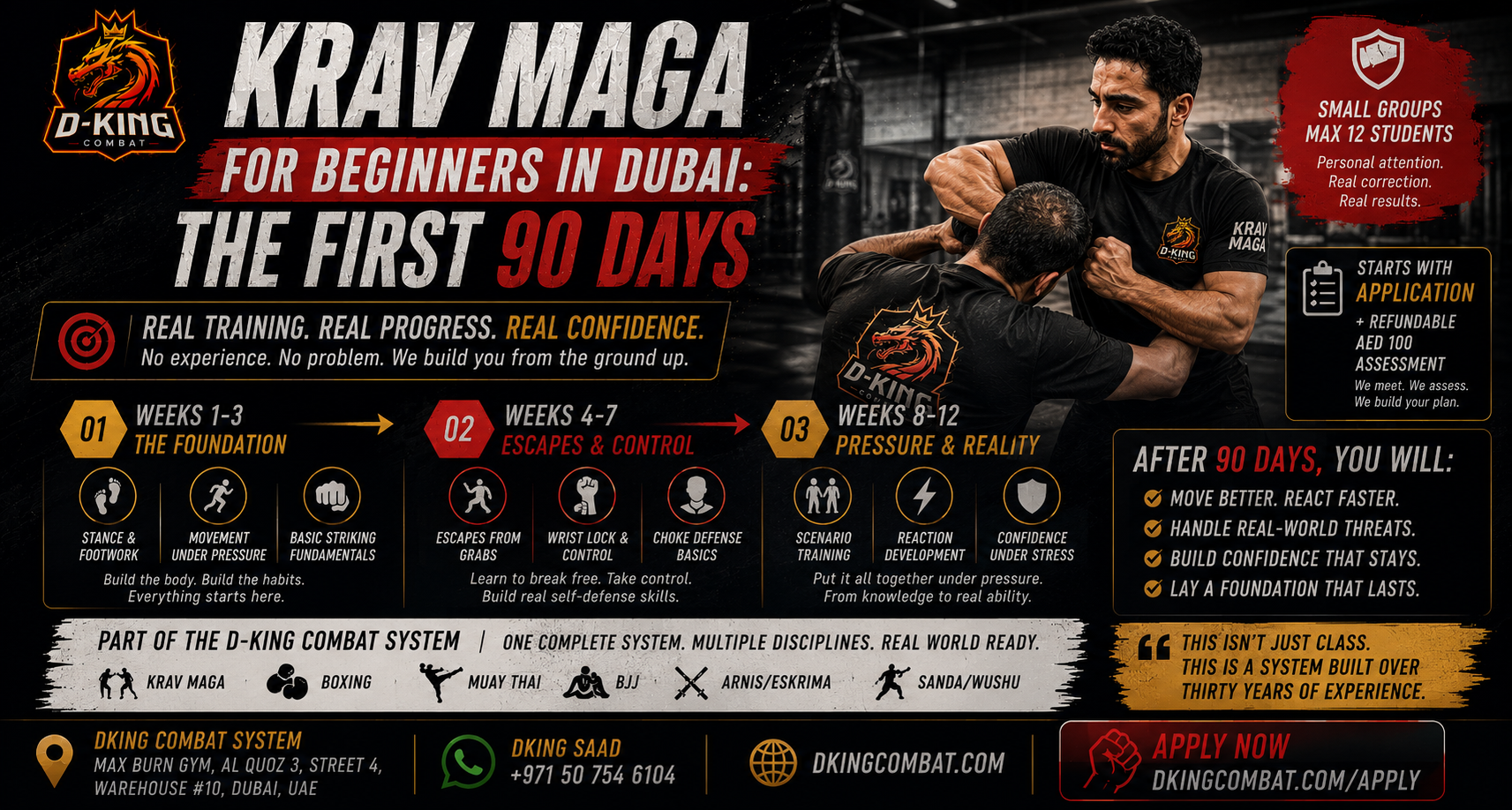
The first 90 days of Krav Maga training at DKing Combat in Al Quoz, Dubai focus on building a physical foundation, stance, movement, and composure under pressure, before layering in escapes, strikes, and real-world scenarios. Most beginners start with zero martial arts background, and training is paced individually, starting with an application and a refundable AED 100 assessment.
What nobody tells beginners before day one
Most people picture their first Krav Maga class as learning a dramatic escape from a chokehold. That's not actually where training starts, and honestly, it shouldn't be. Before any technique holds up under real pressure, your body needs a foundation it doesn't have yet if you've never trained before. The first 90 days are about building that foundation properly, not rushing to feel like you've "learned self-defense" in week one.
Weeks 1 to 3: the unglamorous foundation
This is where most beginners spend more time than they expect, on stance, footwork, and basic movement patterns. It doesn't look exciting from the outside. It's also the single most important stretch of training, because every technique that comes later depends on a body that already moves correctly under stress. Skipping this to rush into flashy technique is exactly how people end up with self-defense skills that fall apart the first time they're actually needed.
You'll also start basic striking fundamentals here, not because striking is the end goal, but because learning to stay calm while something is coming toward you is a skill Krav Maga's real-world techniques depend on entirely.
Weeks 4 to 7: escapes and grip work
Once the foundation holds, we introduce Krav Maga's signature material, escapes from grabs, wrist locks, basic choke defense. This is usually the point where beginners start feeling like the training matches what they expected on day one. The difference is you're now learning it with a body that can actually execute it under pressure, not just memorize a sequence in a calm room.
Weeks 8 to 12: putting it together under pressure
The final stretch introduces controlled, realistic pressure, scenario-based drills where you have to actually respond, not just perform a technique on command. This is where real capability starts showing up, the gap between knowing a technique and being able to produce it under stress starts closing.
By the end of 90 days, most students aren't experts, and I'd never tell you that they are. But they have a genuine foundation: they move differently, react faster, and carry a real sense of what their body can actually do under pressure, not just what they've been told it can do.
What this looks like for total beginners specifically
If you've never trained anything, that's the normal starting point, not a disadvantage. Every student begins with an application and a refundable AED 100 assessment, so training is built around your actual starting point, not a generic beginner template. From there, you're training inside the full DKing Combat System, where Krav Maga sits alongside Boxing, Muay Thai, BJJ, and Arnis/Eskrima as one connected progression.
If you want to understand what Krav Maga specifically trains you for before you start, read Krav Maga in the UAE, Explained.
Group or private training for beginners?
Both work for beginners, and the right choice depends on your pace and goals. Group classes, capped at 12, build skill steadily alongside other students. Private sessions correct every rep individually and can compress the early learning curve significantly for beginners who want a faster start. We compared both in detail here. Pricing for either is on the pricing page.
Frequently Asked Questions
Do I need any experience to start Krav Maga training?
No. Most students at DKing Combat begin with zero martial arts background. Training starts with an application and a refundable AED 100 assessment so the program is built around your actual starting point.
What will I actually learn in my first 90 days of Krav Maga?
The first few weeks focus on stance, movement, and basic striking fundamentals. Weeks four through seven introduce escapes and grip defense. The final stretch adds realistic, scenario-based pressure so technique holds up under real stress, not just in a calm practice setting.
Will I feel confident defending myself after 90 days?
You'll have a real foundation and noticeably improved reactions under pressure, but 90 days builds a strong base, not expert-level mastery. Continued training builds on that foundation over time.
Should beginners choose group or private Krav Maga training?
Either works. Group classes build skill steadily in a small, capped environment. Private sessions correct every rep individually and can speed up the early learning curve for beginners who want faster progress.
How do I start Krav Maga training as a complete beginner?
Apply through dkingcombat.com/apply or message DKing Saad directly on WhatsApp. Every new student starts with a refundable AED 100 assessment.
📍 DKing Combat System, Max Burn Gym, Al Quoz 3, Street 4, Warehouse #10, Dubai, UAE 📞 DKing Saad: +971 50 754 6104 🌐 dkingcombat.com ✅ Apply here: dkingcombat.com/apply
DKing Saad (Saad Iqbal) has coached martial arts and real-world self-defense for more than 20 years and is the founder of the DKing Combat System in Al Quoz, Dubai. More about Saad.