Quick Answer
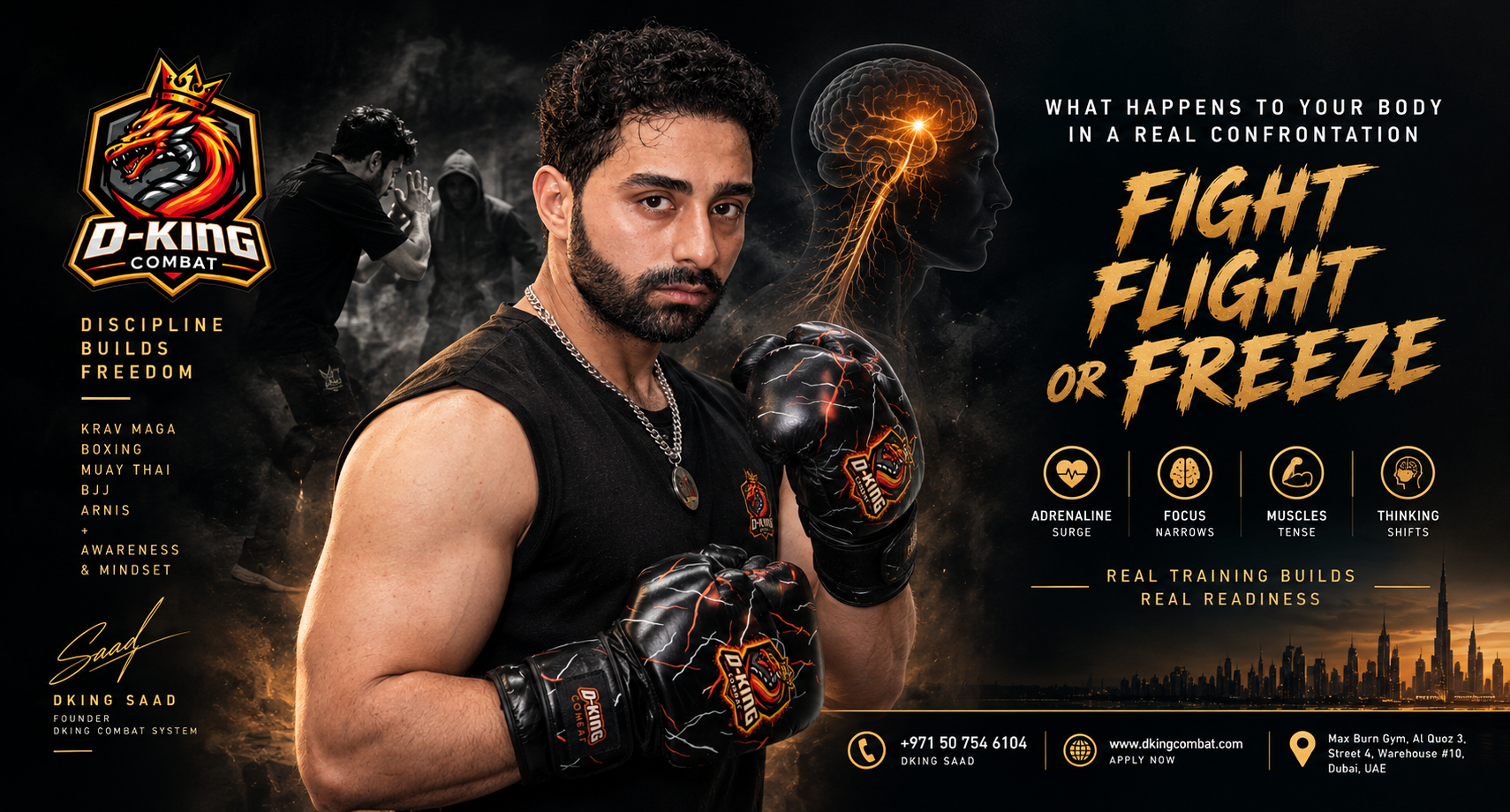
Under real threat, your body releases adrenaline, your heart rate and breathing spike, and your brain shifts from careful thinking toward survival reflexes. That shift can make complex technique hard to recall, and it's why some people freeze. At DKing Combat in Al Quoz, Dubai, adrenal stress training is built into the system so technique holds up when calm doesn't.
Why this matters more than any single technique
Most people assume the gap between "knowing self-defense" and "being able to use it" is a technique gap. Usually it isn't. It's a stress gap. A move that works perfectly in a calm, cooperative drill can become nearly impossible to recall or execute once real fear arrives. Understanding what your body does under threat is the foundation for training in a way that actually accounts for it.
What actually happens in your body
When your brain perceives a serious threat, the amygdala, a part of the brain that acts as an alarm system, sends a distress signal that triggers your sympathetic nervous system. Your adrenal glands release adrenaline. As Harvard Health describes it, the result is a pounding heart, quickened breathing, and tense muscles, along with extra oxygen to the brain that sharpens some senses and a release of blood sugar and fat for a burst of energy.
That response evolved to help you fight or run, and it's genuinely useful. But it comes with trade-offs that matter for self-defense:
Fine motor control tends to degrade. Small, precise movements become harder under high arousal, while large, simple movements hold up better. This is why practical self-defense emphasizes gross motor skills, big and simple actions, over intricate technique.
Attention narrows. Many people report tunnel vision or tuning out surrounding sound during intense stress. The exact effects vary from person to person and situation to situation, so it's best understood as a common tendency rather than a guaranteed script.
Thinking gets harder. Under acute stress, the brain leans on habit and reflex over deliberate analysis, which is why what you've practiced repeatedly matters more than what you've merely learned.
The third response people forget: freeze
Most people know "fight or flight." Far fewer talk about freeze, the response where a person simply cannot move or act. Trauma researchers have described this in people of all backgrounds, including experienced martial artists who knew exactly what to do and still couldn't do it in the moment. It isn't weakness or a character flaw. It's a nervous system response, and it's a major reason why technique alone isn't enough.
What actually helps
Repetition on its own doesn't guarantee that you won't freeze. What genuinely helps is a combination of things:
Training under simulated pressure. Practicing against resisting partners, with realistic stress, lets your nervous system become familiar with the feeling of high arousal in a safe setting, so it's less of a shock when it arrives.
Simple, gross motor techniques. Building responses around big, reliable movements that hold up when fine motor control drops.
Awareness and early decisions. The best outcome is usually avoiding the situation or leaving early, which is why awareness and de-escalation matter more than any physical response.
Composure as a trained skill. The ability to breathe, stay oriented, and make a decision under pressure can be practiced, not just hoped for.
How this shows up in training at DKing Combat
This is the reasoning behind several parts of the DKing Combat System: Pressure-Based Drills, Awareness Training, and Mindset Development are three of its 14 core components, and adrenal stress training is a named part of how Krav Maga is taught here. The measure at DKing Combat isn't whether you can perform a technique in a calm room, it's whether you can do it tired, surprised, and against resistance. For the legal side of what's appropriate once physical action is necessary, see Self-Defense Laws in the UAE, Explained.
An honest limit
No training can promise that you won't freeze in a real situation. What training can do is make freezing less likely, shorten the time it takes to recover, and give you responses that are more available under stress. Anyone who tells you otherwise is overselling.
Frequently Asked Questions
Why do trained people sometimes freeze in a real attack?
Freeze is a nervous system response to overwhelming threat, not a lack of skill or courage. High stress can make recall and movement difficult even for people who know exactly what to do, which is why stress-based training matters.
What is an adrenaline dump?
The rapid release of adrenaline during a perceived threat, causing a racing heart, faster breathing, tense muscles, and heightened alertness, along with common trade-offs like reduced fine motor control.
Why does self-defense focus on simple movements?
Under high stress, fine motor control tends to degrade while large, simple movements hold up better. That's why practical training emphasizes gross motor skills.
Can training prevent me from freezing?
It can reduce the likelihood and help you recover faster by making the stress response familiar, but no honest program can guarantee you won't freeze.
How do I train under realistic pressure in Dubai?
Apply through dkingcombat.com/apply or message DKing Saad directly on WhatsApp.
This article is general educational information and not medical or psychological advice. If you are dealing with trauma or anxiety, please speak with a qualified professional.
📍 DKing Combat System, Max Burn Gym, Al Quoz 3, Street 4, Warehouse #10, Dubai, UAE 📞 DKing Saad: +971 50 754 6104 🌐 dkingcombat.com ✅ Apply here: dkingcombat.com/apply
DKing Saad (Saad Iqbal) has coached martial arts and real-world self-defense for more than 20 years and is the founder of the DKing Combat System in Al Quoz, Dubai. More about Saad.