Quick Answer
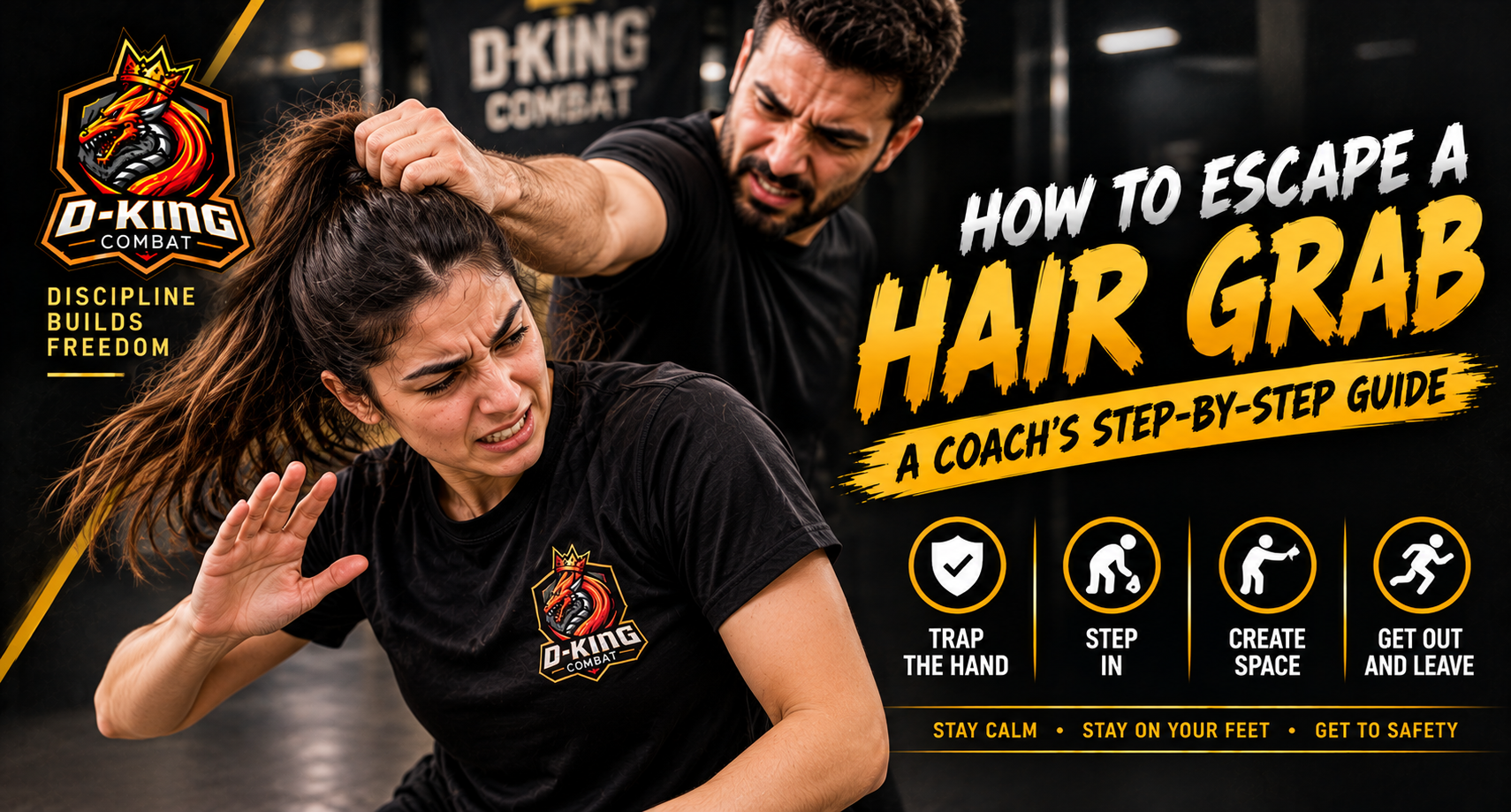
If someone grabs your hair, do not pull away. Pulling against the grip increases the pain, strains your neck and gives the other person control. Instead: trap the hand against your head so they cannot yank or twist, move toward them to take away the leverage, create space with a short strike or an elbow, then break free and leave. The same principles apply whether the grab comes from the front, the side or behind, and to ponytails, braids and some headwear. This is best learned with a qualified instructor and a cooperative partner. This article is general educational information, not a substitute for supervised training.
Why a hair grab is so effective, and so frightening
Hair is attached to a sensitive area, close to your neck, and a grab can control the direction your head moves. It can also be used to pull you off balance or down. The natural reaction, jerking away, tightens the grip and increases pain. That is why training the response matters: your body needs to know what to do before panic takes over. Our articles on the fight, flight or freeze response and why techniques fail under stress explain why.
The principles that apply to every hair-grab escape
- Do not pull away. Pulling creates pain and a stronger grip.
- Trap the hand. Pressing the gripping hand firmly against your head takes pain and leverage away immediately.
- Protect your neck. Keep your chin tucked and your posture low and stable.
- Move toward the person, not away. Closing the distance removes the whip of the pull.
- Create space. Use a short, direct strike or an elbow to open a gap.
- Exit. Turn, break contact and move toward people and safety.
The shorthand: trap, tuck, step in, strike, leave.
Front hair grab
The person is facing you and has taken a handful of hair.
Step by step
- Use both hands to trap their gripping hand to your head, pressing it down firmly so it cannot pull or twist.
- Tuck your chin and drop your weight slightly, with bent knees.
- Step toward them to take out the tension in the pull.
- Create space with a short strike to a vulnerable area or a strong push, while your head stays protected.
- Turn your head and body out as the grip loosens, and release the hand.
- Move away, with your hands up, to safety.
Hair grab from behind
This is more frightening because you cannot see it coming.
Step by step
- Reach up and trap the hand against your head with both of yours.
- Bend forward slightly and tuck your chin, letting your head move with the pull instead of against it.
- Turn toward the pulling arm, pivoting so you face the person as you do.
- Create space with an elbow or a short strike as you turn.
- Break the grip and move away, keeping your hands up.
Side hair grab
- Trap the hand against your head.
- Step toward the person's side, turning your shoulders into them.
- Create space with a short strike or an elbow.
- Release and exit.
Ponytails and braids
A ponytail or braid can be gripped more easily and can be used to pull your head back. The same trap-and-step-in principle applies. Practise taking hold of the base of the hair against your head so the leverage is gone, and avoid pulling forward.
Hijab, scarves and other headwear
Headwear can also be grabbed or pulled. The principles are similar: trap the grabbing hand against your head or neck, keep your posture low and stable, create space and exit. Practise with your own headwear so you know how it behaves. If a scarf is wrapped around your neck, it is a choke risk, and our guide to Krav Maga choke defense is relevant. Coaches can adapt training to what you wear.
If you are pulled to the ground
If a hair grab turns into a takedown:
- Keep your chin tucked and your hand on the gripping hand.
- Protect your head and neck.
- Create space and get back to your feet as soon as you can.
For ground skills, see BJJ and ground survival in the DKing system.
Common mistakes
- Pulling straight away, which tightens the grip and hurts more.
- Reaching for the face instead of trapping the hand.
- Freezing, or waiting for the grip to loosen on its own.
- Standing tall and stiff, which makes you easy to control.
- Staying to fight instead of creating space and leaving.
Long hair and self-defense: do hairstyles matter?
Hairstyle is a small factor. Some people choose tied-back, low or braided styles for training, which can reduce how much can be grabbed, but no hairstyle makes you immune. What matters more is knowing what to do if it happens. Do not change how you live out of fear; learn the response instead.
How to practise safely
- Learn with a qualified instructor and a cooperative partner.
- Start slowly, agree a stop signal and never practise full-force pulls.
- Practise the trap and the step-in until they feel automatic.
- Add pressure gradually. See our guide to sparring for beginners.
Related guides
If a hair grab is the first move, other close-range holds often follow. See our guides to escaping a wrist grab, headlocks and bear hugs and handling a push or shove. For the bigger picture, read our women's self-defense guide and how to de-escalate a confrontation.
The legal side in the UAE
You have a right to defend yourself, but force must be necessary and proportionate, and it must stop once you are free. Escaping and leaving is the safest and most defensible option. Our guide to self-defense laws in the UAE explains the basics. This is not legal advice; consult a licensed UAE lawyer for specific questions.
Learn this properly at DKing Combat
Grab and hold defense are core parts of Krav Maga. DKing Combat System teaches them as part of a structured progression at Max Burn Gym, Al Quoz 3, Dubai. Training begins with an application. Pricing, schedules and availability are best confirmed with DKing Saad or via the apply page. See also what to expect at your first class.
Frequently Asked Questions
What should I do if someone grabs my hair?
Do not pull away. Trap their hand against your head with both of yours, tuck your chin, step toward them, create space with a short strike or elbow, then break free and leave.
Why shouldn't I pull away from a hair grab?
Pulling against the grip increases pain and neck strain and gives the other person more control.
How do I escape a hair grab from behind?
Trap the hand against your head, bend slightly forward, turn toward the pulling arm, create space with an elbow or a short strike and move away.
Can I escape a ponytail or braid grab?
Yes. The same principles apply: trap the hand or the base of the hair against your head, step in and create space.
Does the same advice apply to hijabs and scarves?
The principles are similar: trap the grabbing hand, keep your posture low and stable, create space and exit. A scarf around the neck is a choke risk, so learn choke defense too.
Does my hairstyle make a difference?
A little, but no hairstyle prevents a grab. Knowing the response matters more than changing your style.
Is it safe to practise hair-grab escapes?
Yes, with a qualified instructor, a cooperative partner, slow speed and agreed stop signals. Never practise full-force pulls.
Is it legal to defend myself if someone grabs my hair in the UAE?
Self-defense is recognised, but force must be necessary and proportionate and must stop once you are free. Consult a licensed UAE lawyer for specific questions.
This article is general educational information, not legal advice or a substitute for supervised training. In an emergency in the UAE, call 999.
📍 DKing Combat System, Max Burn Gym, Al Quoz 3, Street 4, Warehouse #10, Dubai, UAE 📞 DKing Saad: +971 50 754 6104 🌐 dkingcombat.com ✅ Apply here: dkingcombat.com/apply
DKing Saad (Saad Iqbal) has coached martial arts and real-world self-defense for more than 20 years and is the founder of the DKing Combat System in Al Quoz, Dubai. More about Saad.