Quick Answer
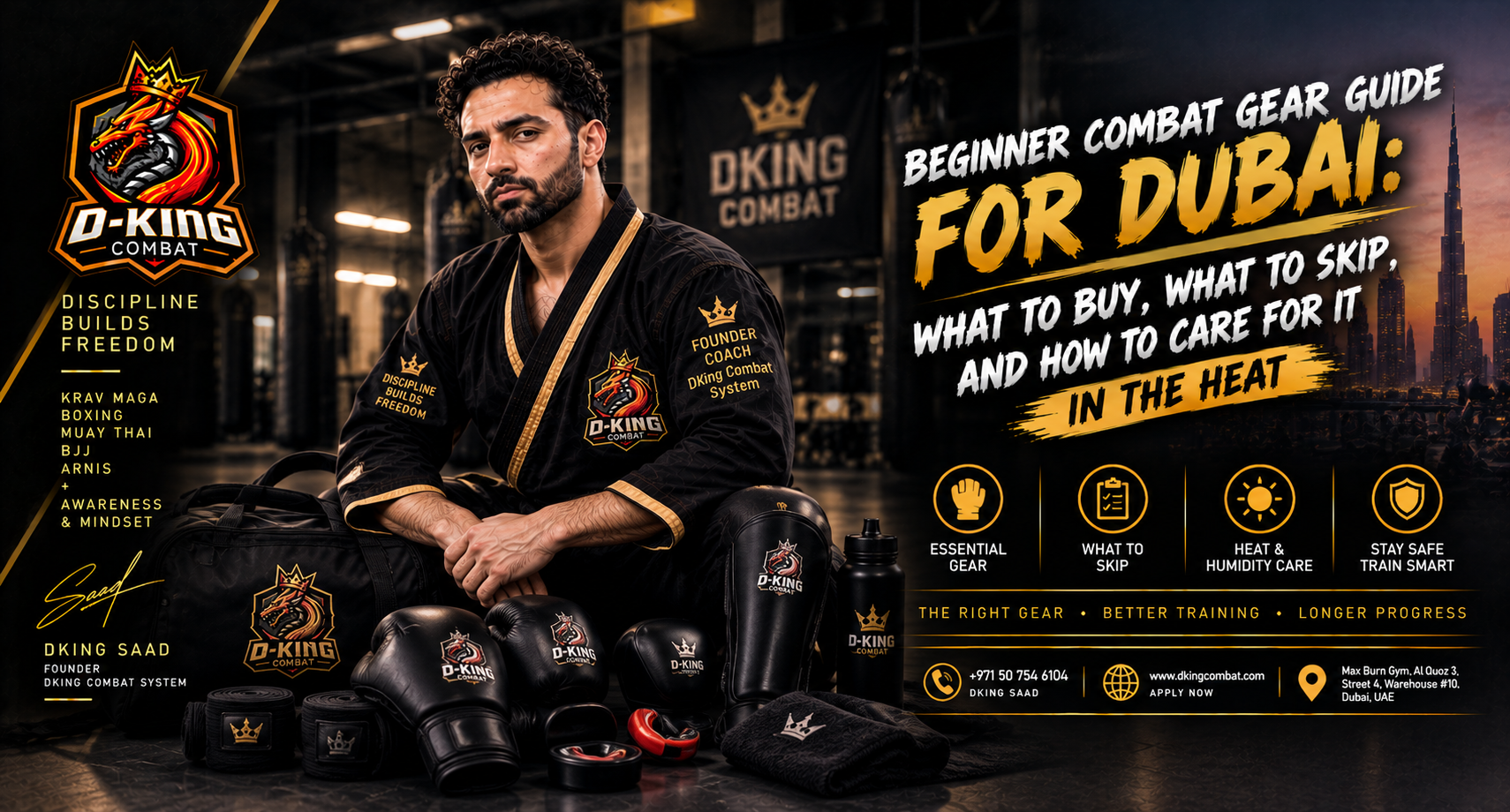
For most beginners, the essentials are hand wraps, a mouthguard and comfortable training clothes, with gloves, shin guards and a groin guard added as your school requires them. Do not buy a full kit before your first class: ask your school what it requires and what it provides, then buy basics of reasonable quality rather than the cheapest or the most expensive. In Dubai's heat and humidity, drying and storing your gear properly matters as much as what you buy. This article is general guidance; always follow your school's own gear rules.
Before you buy anything
- Ask your school. Requirements differ by discipline and by school. Some provide shared gear, some require your own, and some specify types or sizes.
- Start small. Your first few classes tell you what you will actually use.
- Prioritise fit and hygiene over brands.
For what to expect on day one, see our guide to your first self-defense class in Dubai. For DKing Combat's current requirements, ask DKing Saad directly or mention it on the apply page.
The core kit, in priority order
1. Hand wraps
Hand wraps support the small bones and joints of your hands and wrists and absorb sweat.
- What to look for: a comfortable, stretchy-but-firm cotton blend, a thumb loop and a hook-and-loop closure.
- Length: longer wraps give more coverage; many beginners find a longer option easier to wrap neatly. Ask your coach what they recommend.
- Why they matter: they reduce the risk of hand and wrist strain, particularly once you start hitting bags and pads.
- Tip: have your coach show you how to wrap before you rely on it. A poorly wrapped hand gives little protection.
- Care: buy two pairs so one can dry while you use the other.
2. Mouthguard
If your training includes sparring or any face-contact, a mouthguard is one of the most important pieces of kit.
- Boil-and-bite: inexpensive, moulded at home, a good starting point for many beginners.
- Custom-fitted: made by a dentist, more comfortable and secure, and often chosen by people who train regularly.
- Fit: it should be snug, not loose or choking, and allow you to breathe.
- Care: rinse after each use, let it dry fully and keep it in a ventilated case.
3. Training clothes
- Breathable, moisture-wicking fabric suits the climate.
- Fitted tops avoid snagging on grabs and holds.
- Flexible shorts or trousers with room for kicks and movement.
- Avoid jewellery and anything that can catch, such as zips or loose chains.
4. Gloves
Whether you need gloves depends on your discipline and school.
- Bag or pad gloves are padded for hitting; sparring gloves are heavier for partner work.
- Weight and size: glove weight is measured in ounces and usually increases with your size and with the type of training. Ask your coach which size suits you before buying.
- Fit: snug but not tight, with your wrapped hand fully inside.
- Beginners: a mid-range pair from a reputable maker is usually better than the cheapest, which can break down quickly.
5. Shin guards and groin guard
- Shin guards are used in disciplines with kicks, such as Muay Thai and some Krav Maga drills. Choose a size that stays in place without cutting off circulation.
- Groin guard is standard for anything with partner contact. Check fit with your coach.
6. Optional extras
- Headgear for harder sparring, if your school uses it.
- Gym bag with a ventilated compartment.
- Water bottle and towel.
What to skip at the start
- A full pro kit before you know your discipline.
- Heavy bag gloves for sparring and the reverse. Use the right tool for the job.
- Very cheap, thin-padded gear, which can protect poorly.
- Gear you cannot try on or ask about. Fit matters.
Gear for each discipline, in brief
- Krav Maga: comfortable clothes, hand wraps, a mouthguard and, depending on the drills, gloves and protective gear. See what Krav Maga is.
- Boxing: wraps, gloves and a mouthguard. See boxing classes in Dubai.
- Muay Thai: wraps, gloves, shin guards, a mouthguard and a groin guard. See Muay Thai for beginners.
- BJJ: a gi or no-gi kit and a mouthguard, depending on the class. See BJJ in Dubai.
Caring for gear in Dubai's heat and humidity
This is where gear often fails faster than people expect.
- Dry it after every session. Open gloves and wraps to the air, and do not leave them zipped in a bag.
- Never leave gear in a hot car. Heat damages foam, glue and leather and speeds up bacteria and odour.
- Wash hand wraps and clothes after every use.
- Use a glove deodoriser or a breathable inner, and wipe gloves down with a damp cloth regularly.
- Rotate pairs if you train often.
- Rinse your mouthguard and dry it fully.
- Replace worn gear. Cracked foam, loose stitching or a poor fit means less protection.
Hygiene and skin health
Shared mats and gear can spread skin infections. Shower after training, keep cuts covered, wash your kit regularly and do not share your mouthguard or wraps. See our injury prevention and recovery guide for more on staying healthy.
How much should I spend?
There is no single figure. A sensible approach is to buy a few good basics rather than a full cheap set, replace items as they wear, and avoid paying for brand alone. Ask your coach for recommendations, and compare current prices yourself. This article does not quote prices.
Common beginner mistakes
- Buying everything before the first class.
- Choosing gloves that are too small or too large.
- Skipping the mouthguard.
- Leaving gear in a hot bag or car.
- Using worn-out gear.
Start training with DKing Combat in Dubai
DKing Combat System trains at Max Burn Gym, Al Quoz 3, Dubai. For current gear requirements, class schedules and availability, ask DKing Saad directly. Training begins with an application. If you are still choosing where to start, see our beginner roadmap and how to choose a self-defense school.
Frequently Asked Questions
What do I need for my first Krav Maga class?
Comfortable training clothes and water are the basics. Ask your school whether you need wraps, a mouthguard or other gear before your first session.
Do I need my own gloves as a beginner?
It depends on your school and discipline. Some provide shared gloves; many people prefer their own for hygiene and fit. Ask your coach before buying.
What size boxing gloves should a beginner buy?
Glove weight is measured in ounces and depends on your size and the type of training. Ask your coach for a recommendation rather than guessing.
What is the difference between boil-and-bite and custom mouthguards?
Boil-and-bite guards are moulded at home and are inexpensive. Custom guards are made by a dentist, fit more securely and are usually more comfortable.
How do I stop my gloves smelling?
Dry them after every session, never leave them in a closed bag or hot car, wipe the inside regularly and use a deodoriser.
How should I look after gear in Dubai's heat?
Dry it immediately, keep it out of hot cars, wash wraps and clothing after every use and replace worn items.
Do I need shin guards for Krav Maga?
It depends on the drills and your school. They are standard in Muay Thai. Ask your coach.
How much does beginner combat gear cost?
Prices vary widely by brand and quality. Ask your coach what is essential and compare current prices.
This article is general guidance. Always follow your school's gear requirements. Consult a doctor or dentist about specific health or fitting questions.
📍 DKing Combat System, Max Burn Gym, Al Quoz 3, Street 4, Warehouse #10, Dubai, UAE 📞 DKing Saad: +971 50 754 6104 🌐 dkingcombat.com ✅ Apply here: dkingcombat.com/apply
DKing Saad (Saad Iqbal) has coached martial arts and real-world self-defense for more than 20 years and is the founder of the DKing Combat System in Al Quoz, Dubai. More about Saad.