Quick Answer
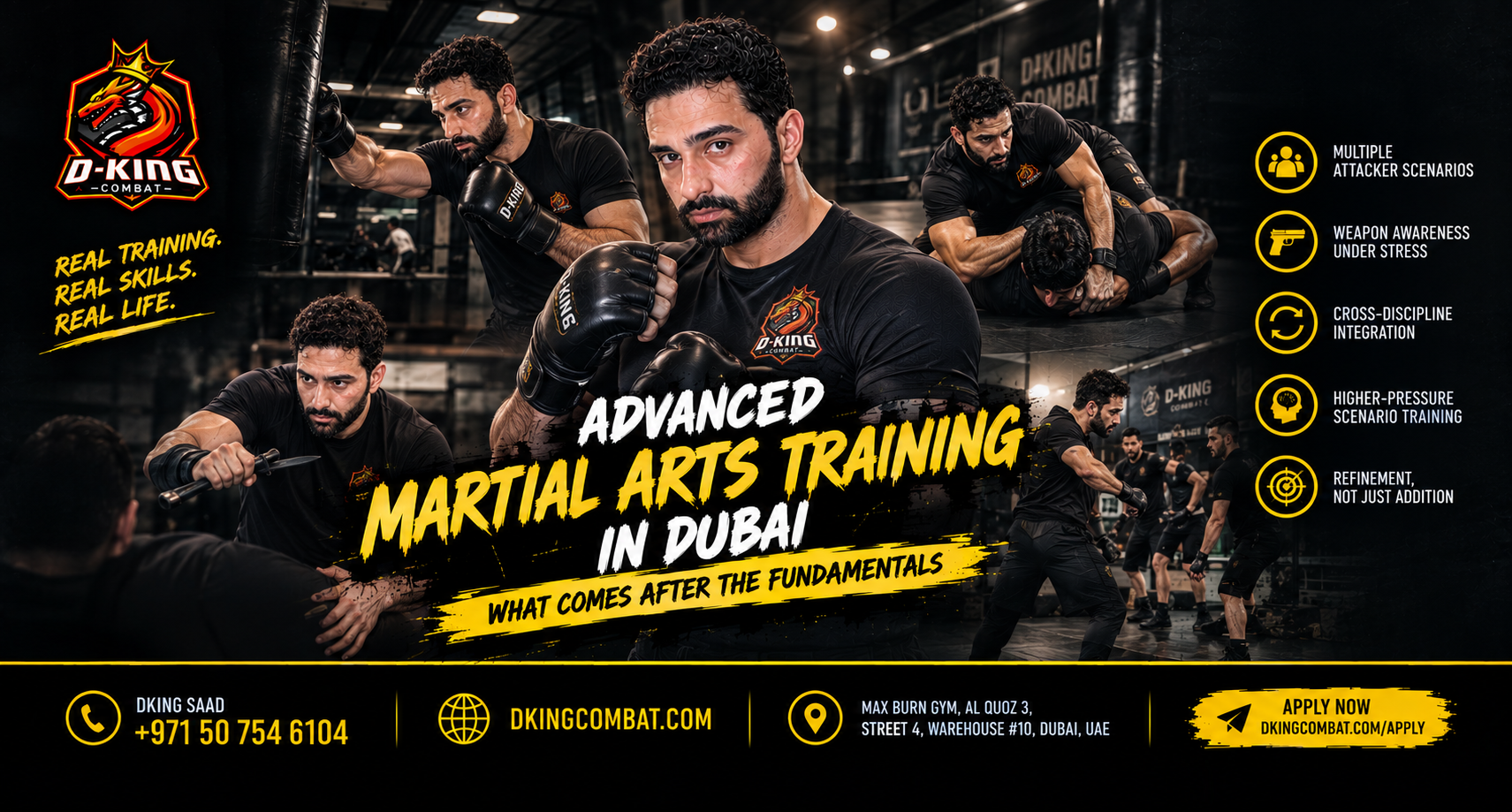
Advanced training at DKing Combat moves beyond isolated technique into realistic, pressure-tested application, multiple attacker scenarios, weapon awareness under stress, and cross-discipline integration where striking, clinch, and ground transitions happen fluidly rather than as separate skills. It's built for students who've genuinely internalized the fundamentals, not a fixed timeline everyone reaches at the same pace.
Why advanced training gets so little attention
Most content about martial arts and self-defense training, including a lot of our own, understandably focuses on beginners. That's where most people start, and it's where the most common questions come from. But it leaves a real gap for students who've put in real time, built genuine fundamentals, and want to know what's actually next. Advanced training deserves the same honest, specific treatment beginner content gets.
How you know you're ready for advanced training
There's no arbitrary belt or certificate that marks this transition inside the DKing Combat System, since the system itself doesn't use belts or competition as its measure of progress. What actually indicates readiness is more practical: fundamentals that hold up under real fatigue and pressure, not just in a calm drill, genuine comfort transitioning between striking, clinch, and ground ranges rather than treating them as separate skills, and the composure to make decisions under stress rather than freezing or defaulting to panic.
What advanced training actually adds
Multiple-attacker scenarios. Fundamentals are built around a single threat. Advanced training introduces the added complexity of managing space, positioning, and threat prioritization when more than one person is involved.
Weapon awareness under realistic pressure. Beyond basic disarms taught in isolation, advanced training integrates weapon threats into live, unpredictable scenarios, closer to how a real situation would actually unfold.
Fluid cross-discipline integration. Rather than practicing Krav Maga, Boxing, Muay Thai, BJJ, or Arnis as separate blocks, advanced students train transitions between them, a confrontation moving from striking range into a clinch and onto the ground within seconds, without a reset between each phase.
Higher-pressure scenario training. Realistic, escalating pressure that tests decision-making under genuine stress, not just physical technique, becomes a bigger part of training at this stage.
Refinement, not just addition. A meaningful part of advanced training is returning to fundamentals with a more critical eye, tightening technique that's been "good enough" for a while but hasn't been refined to its actual potential.
Why this still isn't taught in isolation
Even at an advanced level, training stays connected to the full DKing Combat System rather than narrowing into a single specialization. The goal was never to produce a specialist in one discipline, it's to produce someone genuinely capable across the full range of what a real confrontation could actually involve.
How this is structured for you specifically
Advanced training isn't a fixed program every student enters at the same point. It's scoped individually, building on your specific strengths and gaps as a student DKing Saad has already coached, which is part of why the small group model and direct coaching relationship matters as much at this stage as it did when you started.
Frequently Asked Questions
How do I know if I'm ready for advanced training?
There's no fixed belt or certificate marking this transition. Readiness shows up practically: fundamentals that hold up under real pressure, comfort transitioning between striking, clinch, and ground ranges, and composure under stress.
What does advanced training add that fundamentals don't cover?
Multiple-attacker scenarios, weapon awareness under realistic pressure, fluid transitions between disciplines, and higher-pressure decision-making training, alongside ongoing refinement of fundamentals.
Does advanced training focus on one discipline specifically?
No. It stays connected to the full DKing Combat System, striking, clinch, ground, and weapon awareness together, rather than narrowing into a single specialization.
How long does it take to reach advanced training?
There's no fixed timeline. Progress is based on demonstrated competency and readiness rather than time served, and it's assessed individually by DKing Saad.
How do I progress toward advanced training?
If you're already training at DKing Combat, this is a conversation to have directly with DKing Saad about where you currently stand. If you haven't started yet, building your fundamentals is the necessary first step. Apply through dkingcombat.com/apply.
📍 DKing Combat System, Max Burn Gym, Al Quoz 3, Street 4, Warehouse #10, Dubai, UAE 📞 DKing Saad: +971 50 754 6104 🌐 dkingcombat.com ✅ Apply here: dkingcombat.com/apply
DKing Saad (Saad Iqbal) has coached martial arts and real-world self-defense for more than 20 years and is the founder of the DKing Combat System in Al Quoz, Dubai. More about Saad.