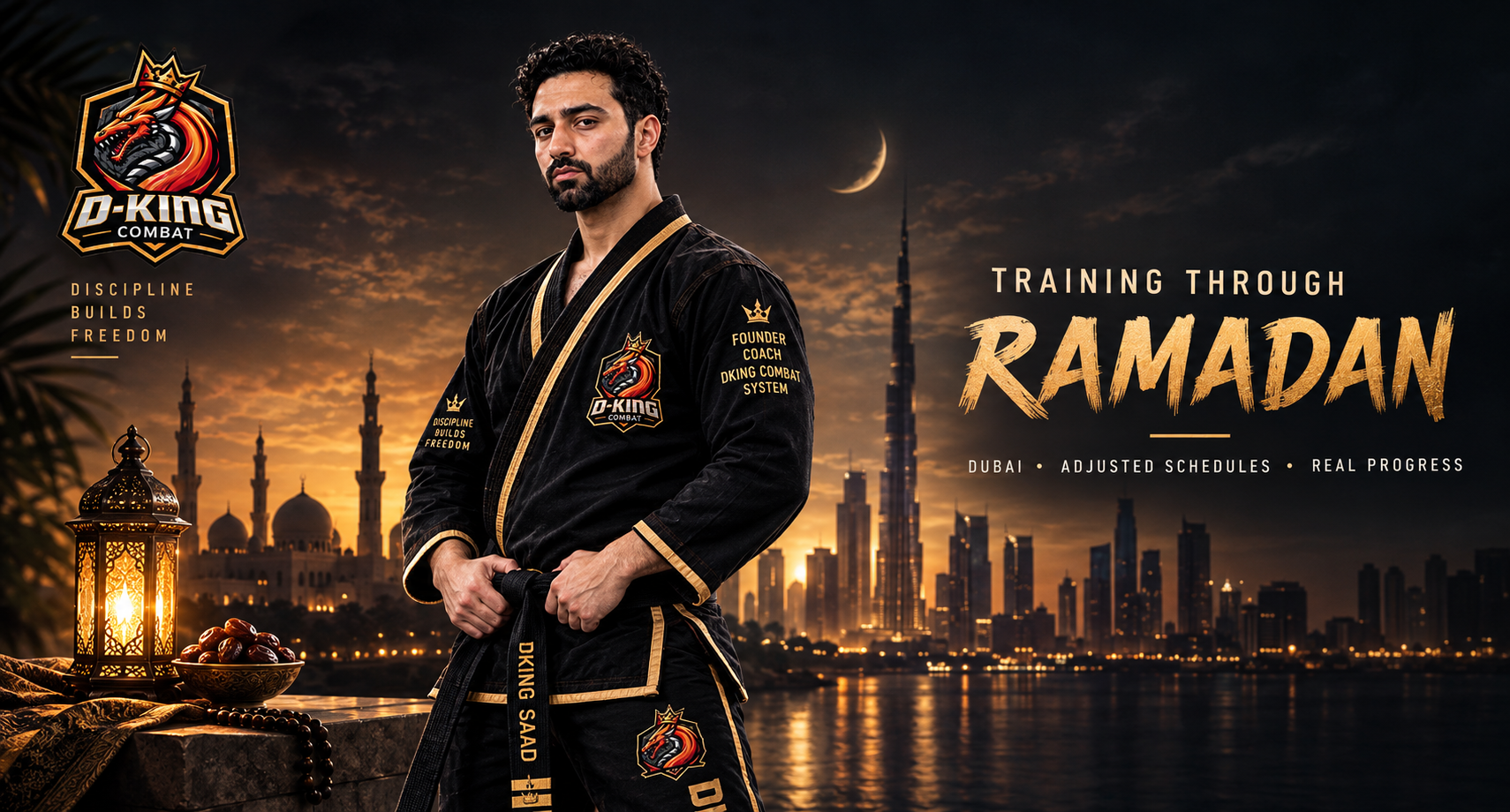
Quick Answer
Training continues through Ramadan at DKing Combat, with adjusted scheduling to work around fasting hours, typically shifting toward the evening after Iftar when energy levels are more consistent. Both fasting and non-fasting students train throughout the month, and intensity is scoped to what makes sense for each individual during this period, not a fixed, unchanged program.
Why Ramadan genuinely changes the rhythm of training
Dubai's entire rhythm shifts during Ramadan, adjusted working hours, quieter streets during the day, and a different pace of life for much of the city. Training reflects that same shift. For students who are fasting, energy levels and hydration naturally follow a different pattern through the day, and pretending nothing has changed would be a disservice to the people showing up during a meaningful, demanding month.
How scheduling typically adjusts
Sessions commonly shift toward evening hours, after Iftar, when fasting students have eaten and rehydrated and can train with genuine energy rather than pushing through depletion. This isn't a fixed rule for everyone, non-fasting students, or those observing Ramadan differently, may have other scheduling needs, and private sessions in particular can be scoped around what actually works for your specific situation during the month.
What actually changes about the training itself
Intensity is scoped individually. Training during a fasting state isn't the same as training on a normal day, and pretending otherwise isn't good coaching. For fasting students, sessions are adjusted with that reality in mind, rather than expecting the same output as any other week.
Hydration and timing matter more than usual. Scheduling sessions with enough time after breaking the fast to rehydrate and eat properly makes a real difference in how training actually feels and how safely it can be done.
The core system doesn't pause. Krav Maga, Boxing, Muay Thai, BJJ, Arnis, and the rest of the DKing Combat System continue to be taught throughout Ramadan, just with schedule and intensity adjustments that respect what the month actually involves for fasting students.
A note on training while fasting
This is genuinely personal, and it's worth treating it that way rather than with a one-size-fits-all rule. Some students train comfortably while fasting, particularly once their body adjusts to the rhythm of the month. Others prefer to train exclusively after Iftar, or scale back intensity significantly during fasting hours. If you have any underlying health considerations, checking with a doctor about exercising while fasting is worth doing before committing to a specific approach, this is general guidance, not personalized medical advice.
For non-Muslim students training during Ramadan
If you're not fasting yourself, training continues largely as normal, though it's worth being mindful of the broader shift in the city's rhythm, adjusted hours at surrounding businesses, quieter daytime streets, and a generally different pace. Evening sessions often end up being a natural fit for everyone during this period, fasting or not, simply because that's when the city's energy picks back up.
How to plan your training for Ramadan
If you're a current student, the simplest approach is a direct conversation with DKing Saad about what schedule and intensity make sense for you this month. If you're considering starting training and Ramadan is approaching, that's still a completely reasonable time to begin, the initial assessment can account for the season directly rather than assuming a standard non-Ramadan pace.
Frequently Asked Questions
Does training continue at DKing Combat during Ramadan?
Yes. Scheduling typically shifts toward evening hours after Iftar, and training continues for both fasting and non-fasting students throughout the month.
Is it safe to train while fasting?
This varies by individual. Many students train comfortably while fasting, particularly with adjusted intensity and timing. If you have any underlying health considerations, check with a doctor before training while fasting.
Will my training intensity be reduced during Ramadan?
For fasting students, intensity is typically scoped to what makes sense during the month rather than staying identical to a non-Ramadan schedule. This is discussed individually, not applied as a blanket rule.
Can I start training for the first time during Ramadan?
Yes. The initial assessment can be scoped around the season directly, so there's no need to wait until after Ramadan to begin.
How do I find out what schedule works for me during Ramadan?
Message DKing Saad directly on WhatsApp or apply through dkingcombat.com/apply to discuss a schedule that fits your situation this month.
📍 DKing Combat System, Max Burn Gym, Al Quoz 3, Street 4, Warehouse #10, Dubai, UAE 📞 DKing Saad: +971 50 754 6104 🌐 dkingcombat.com ✅ Apply here: dkingcombat.com/apply
DKing Saad (Saad Iqbal) has coached martial arts and real-world self-defense for more than 20 years and is the founder of the DKing Combat System in Al Quoz, Dubai. More about Saad.