Quick Answer
Conflict with difficult, frustrated, or occasionally aggressive customers is a well-documented reality in retail and hospitality work globally, covered by workplace safety authorities, retail research, and recurring news coverage of frontline staff facing threats over refunds, service complaints, and disputes. Dubai's retail and F&B sector is genuinely safe by any standard measure, but staff in customer-facing roles still benefit from real training in de-escalation, boundary-setting, and knowing when to disengage, skills that protect both the employee and the customer relationship.
Why this deserves real training, not just a policy document
Most retail and hospitality businesses have a customer service policy somewhere in a handbook. Far fewer actually train staff in the practical skill of de-escalating a tense interaction in the moment, when a dissatisfied customer's tone shifts, voices rise, and the person facing them, often young, often alone at a counter or table, has to make real decisions quickly. This gap between written policy and trained response is exactly where genuine preparation adds value.
What this is actually about
This is overwhelmingly a conversation about communication, not combat. The vast majority of tense customer interactions, refund disputes, service complaints, long queues, mistaken orders, resolve through calm, confident communication long before anything physical becomes relevant. The goal of training here is giving staff the tools and the composure to handle that 95% of situations well, while knowing exactly what to do in the rare remainder.
The skills that actually matter, in order
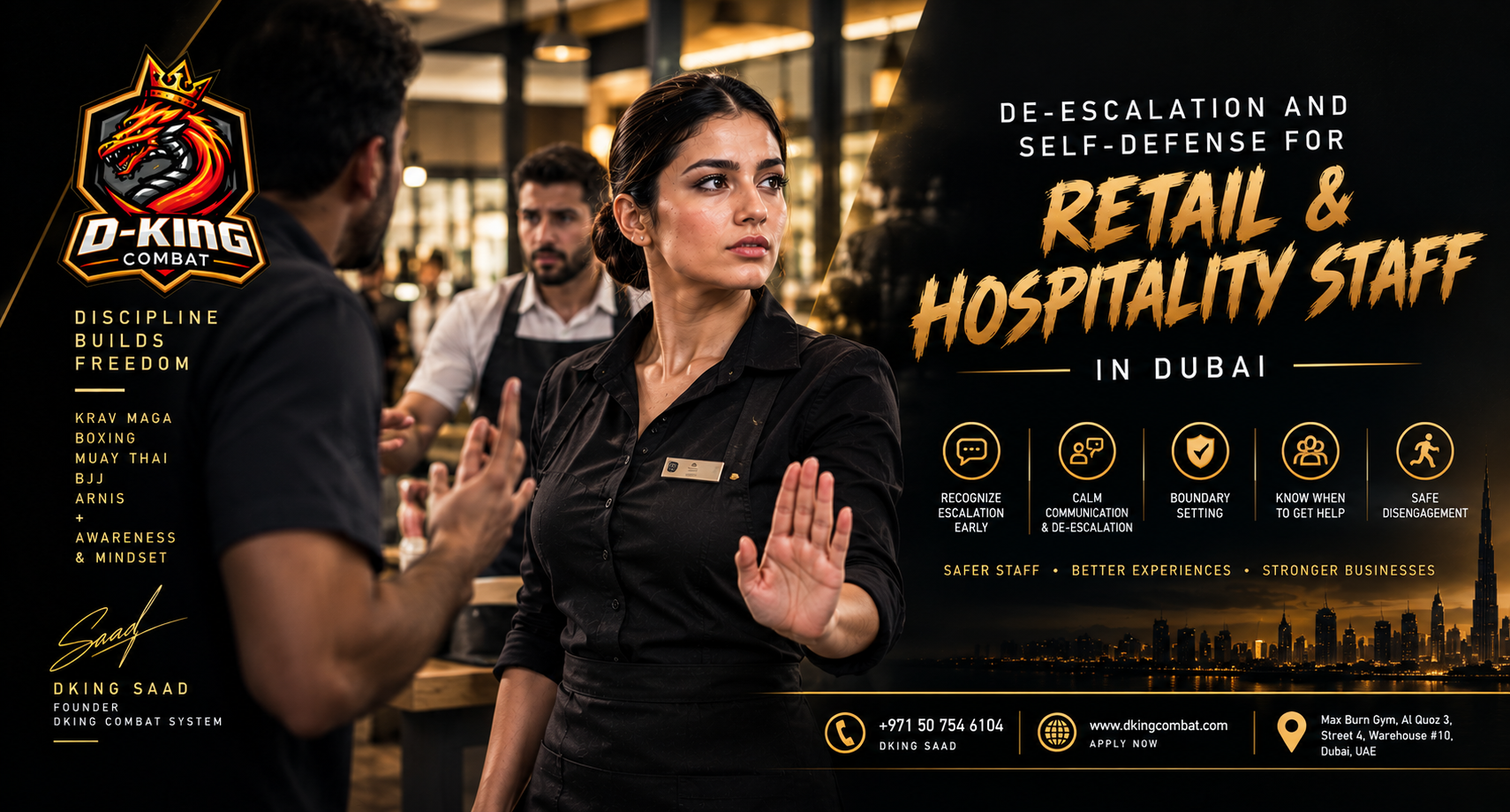
Recognizing escalation early. Raised volume, rapid speech, closed body language, these are signals a situation is heating up before it becomes a real problem. Catching this early gives staff far more options than waiting until a customer is already shouting.
De-escalation through tone and language. Calm, non-defensive language, genuine acknowledgment of frustration, and avoiding words that inadvertently provoke further anger. This is a trainable communication skill, not an innate personality trait, and it resolves most situations on its own.
Knowing when to involve a manager or security. Staff shouldn't be expected to personally resolve every escalating situation alone. Clear, practiced protocols for bringing in a manager or security team member at the right moment protect both the employee and the business.
Setting a firm, calm boundary. There's a real skill in telling a customer clearly that a certain behavior isn't acceptable, without escalating the tension further. This is assertiveness, not confrontation.
Safe disengagement, as a last resort. In the rare case a situation does become physical or genuinely threatening, the priority is distance and safety, removing yourself and reaching help, not managing or controlling the other person.
Why Dubai's safety record doesn't make this irrelevant
The UAE consistently ranks among the safest countries in the world, and that's a genuine, well-earned reputation, not a selling point we're using loosely. But safety at the national level doesn't eliminate the ordinary human reality of frustrated customers, service disputes, and occasional tempers that every retail and hospitality market in the world experiences, documented consistently across workplace safety research globally. Training for this is proportionate preparation, the same logic behind any professional safety training, not a response to Dubai being unusually risky.
For business owners and managers
If you manage frontline staff, in retail, F&B, or hospitality, this is a legitimate area for team training investment, scoped specifically to the kind of interactions your staff actually face. A corporate training session focused on real de-escalation and composure under pressure gives your team something genuinely useful, well beyond a generic customer service refresher.
How this connects to training at DKing Combat
This draws on the same Awareness Training and Mindset Development components used across the DKing Combat System, applied to a customer-facing context where the priority is calm resolution, not confrontation.
Frequently Asked Questions
Is customer conflict actually a common issue in retail and hospitality?
Globally documented, yes, workplace safety authorities and retail research consistently cover this as a genuine occupational reality, particularly around refund disputes, service complaints, and high-pressure periods. It's a legitimate training topic, not an exaggerated concern.
Does this training involve physical combat techniques?
Minimally, and only as an absolute last resort. The overwhelming focus is de-escalation, communication, and knowing when to involve a manager or security, since that's what resolves almost every real situation.
Is Dubai particularly risky for retail or hospitality workers?
No. The UAE is one of the safest countries in the world. This training is proportionate professional preparation, not a response to unusual local risk.
Can this be delivered as team training for a business?
Yes. Corporate sessions can be scoped specifically to customer-facing roles and the kinds of interactions your team actually encounters.
How do I arrange this training for myself or my team?
Apply through dkingcombat.com/apply or message DKing Saad directly on WhatsApp to discuss individual or team training.
📍 DKing Combat System, Max Burn Gym, Al Quoz 3, Street 4, Warehouse #10, Dubai, UAE 📞 DKing Saad: +971 50 754 6104 🌐 dkingcombat.com ✅ Apply here: dkingcombat.com/apply
DKing Saad (Saad Iqbal) has coached martial arts and real-world self-defense for more than 20 years and is the founder of the DKing Combat System in Al Quoz, Dubai. More about Saad.