Quick Answer
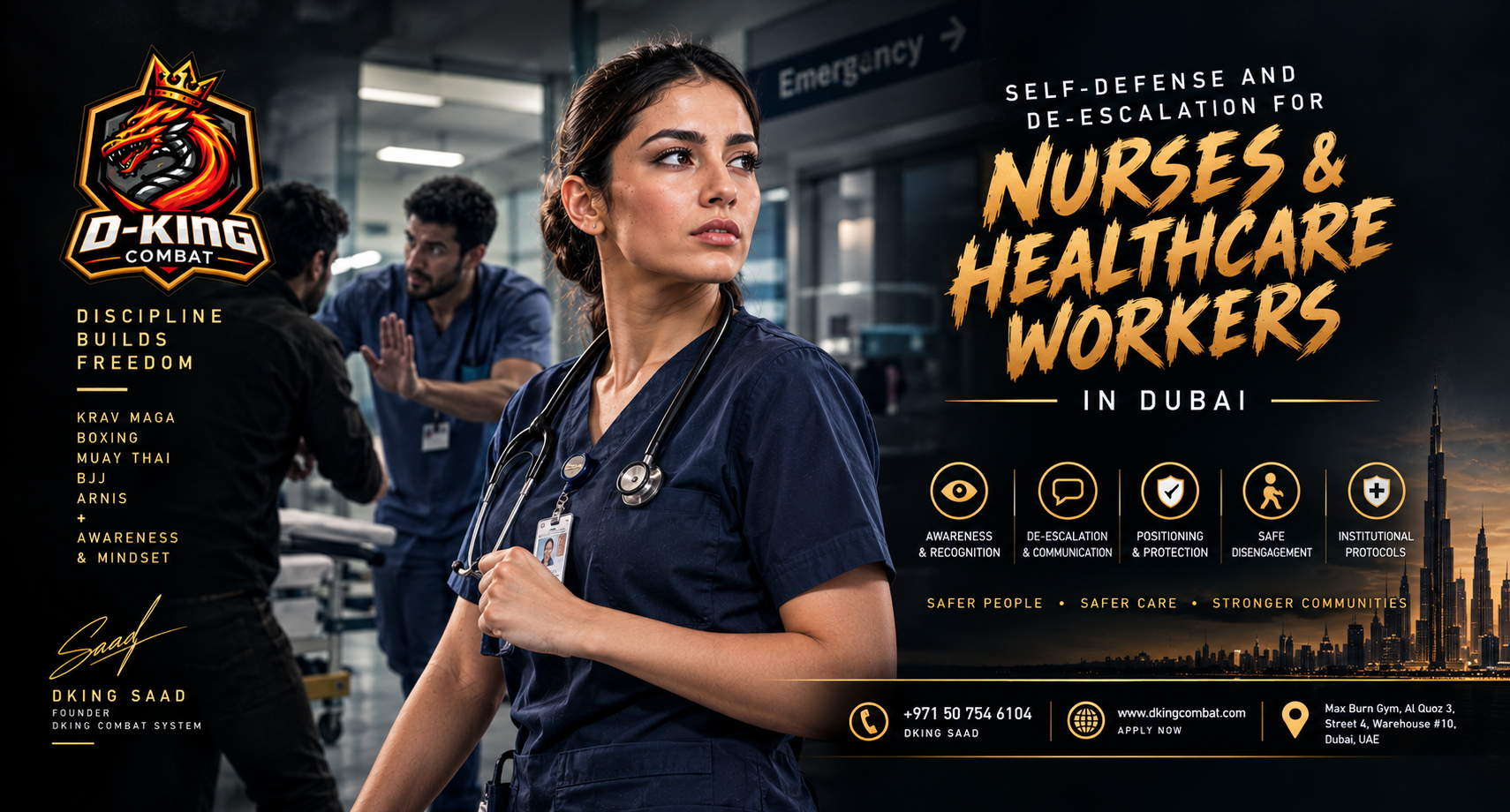
Workplace violence against healthcare workers, particularly nurses in emergency and high-acuity settings, is a well-documented occupational issue recognized globally by organizations including the World Health Organization and the International Labor Organization. This isn't about training nurses to fight patients, it's about de-escalation, boundary-setting, and safe physical disengagement, skills that support the caregiving relationship rather than working against it.
An important distinction before anything else
Self-defense for healthcare workers is fundamentally different from self-defense in most other contexts. A nurse can't simply walk away from an agitated patient the way someone might leave an uncomfortable situation on the street, there's an ongoing duty of care, a professional relationship, and often a genuine medical or psychological reason behind the aggression itself. Any training approach that ignores this context and just teaches generic striking technique isn't actually useful here, and could genuinely make things worse. What matters is de-escalation first, protective positioning and safe disengagement second, and appropriate physical response, focused on safety rather than harm, only when genuinely necessary.
Why this is a real, documented occupational issue
This isn't a niche concern. Global research across multiple countries consistently shows healthcare workers, and nurses specifically, report high rates of verbal and physical aggression from patients and visitors, with emergency departments and high-stress clinical settings showing the highest rates. The World Health Organization and International Council of Nurses have both recognized this as a significant occupational safety issue worldwide, not an isolated problem in any one country or healthcare system. Naming this honestly matters, healthcare workers who've experienced this aren't overreacting, and preparation for it is legitimate professional development, not an overreaction to a rare event.
What actually helps, in the order it actually matters
Recognizing escalation early. Agitation, confusion, pain, fear, and substance effects can all precede aggressive behavior. Recognizing these signals early, before a situation becomes physical, is the most valuable skill in this context by a significant margin.
De-escalation and calm communication. Tone, body language, and verbal technique that reduce tension rather than inadvertently increasing it. This is the primary tool in almost every situation, and it resolves the vast majority of tense interactions before anything physical becomes relevant.
Positioning and spatial awareness. Simple habits, maintaining access to an exit, avoiding being cornered, keeping appropriate distance during a tense interaction, that reduce risk without requiring any physical technique at all.
Safe disengagement and protective control. When a situation does become physical, the goal is safety and separation, not overpowering or harming the other person. This is a meaningfully different skill set than general self-defense training, and it should be trained as such.
Institutional protocol, always first. Facility security procedures, panic buttons, team response protocols, and reporting systems are the actual first line of response in a healthcare setting, and personal training supplements that system, it never replaces it.
Why generic self-defense training isn't the right fit here
A lot of self-defense training is built around scenarios where disengaging entirely and leaving is always the right answer. In healthcare, that's often not possible or appropriate, the nurse still has a patient to care for, a team relying on them, and a professional obligation that doesn't simply end because a situation became tense. Training relevant to this profession needs to account for that reality directly, rather than applying a framework built for a completely different context.
How this connects to broader training principles
The same Awareness Training and Pressure-Based Drills components used across the DKing Combat System apply here, scoped specifically to a caregiving context rather than a confrontational one. Given the demanding, often unpredictable shift patterns common in healthcare work, private sessions tend to be far more practical than a fixed group class schedule.
Frequently Asked Questions
Is workplace violence against healthcare workers actually common?
Global research consistently documents this as a real, significant occupational issue, recognized by organizations including the WHO and International Council of Nurses, particularly in emergency and high-acuity settings. It's a genuine professional safety topic, not an exaggerated concern.
Does this training teach nurses to fight back against patients?
No. The priority order is de-escalation, positioning, and safe disengagement. Physical response is framed around safety and protective separation, not overpowering or harming a patient, which reflects the genuinely different context healthcare work involves.
Should this replace hospital security protocols?
No. Facility security procedures, panic systems, and team response protocols remain the primary response framework. Personal training is a complementary layer, not a replacement.
Can training work around irregular hospital shift schedules?
Yes. Private sessions in particular can be scheduled around unpredictable rosters more easily than a fixed weekly group class.
How do I start training as a healthcare professional in Dubai?
Apply through dkingcombat.com/apply or message DKing Saad directly on WhatsApp to discuss a schedule that fits your shifts.
📍 DKing Combat System, Max Burn Gym, Al Quoz 3, Street 4, Warehouse #10, Dubai, UAE 📞 DKing Saad: +971 50 754 6104 🌐 dkingcombat.com ✅ Apply here: dkingcombat.com/apply
DKing Saad (Saad Iqbal) has coached martial arts and real-world self-defense for more than 20 years and is the founder of the DKing Combat System in Al Quoz, Dubai. More about Saad.