Quick Answer
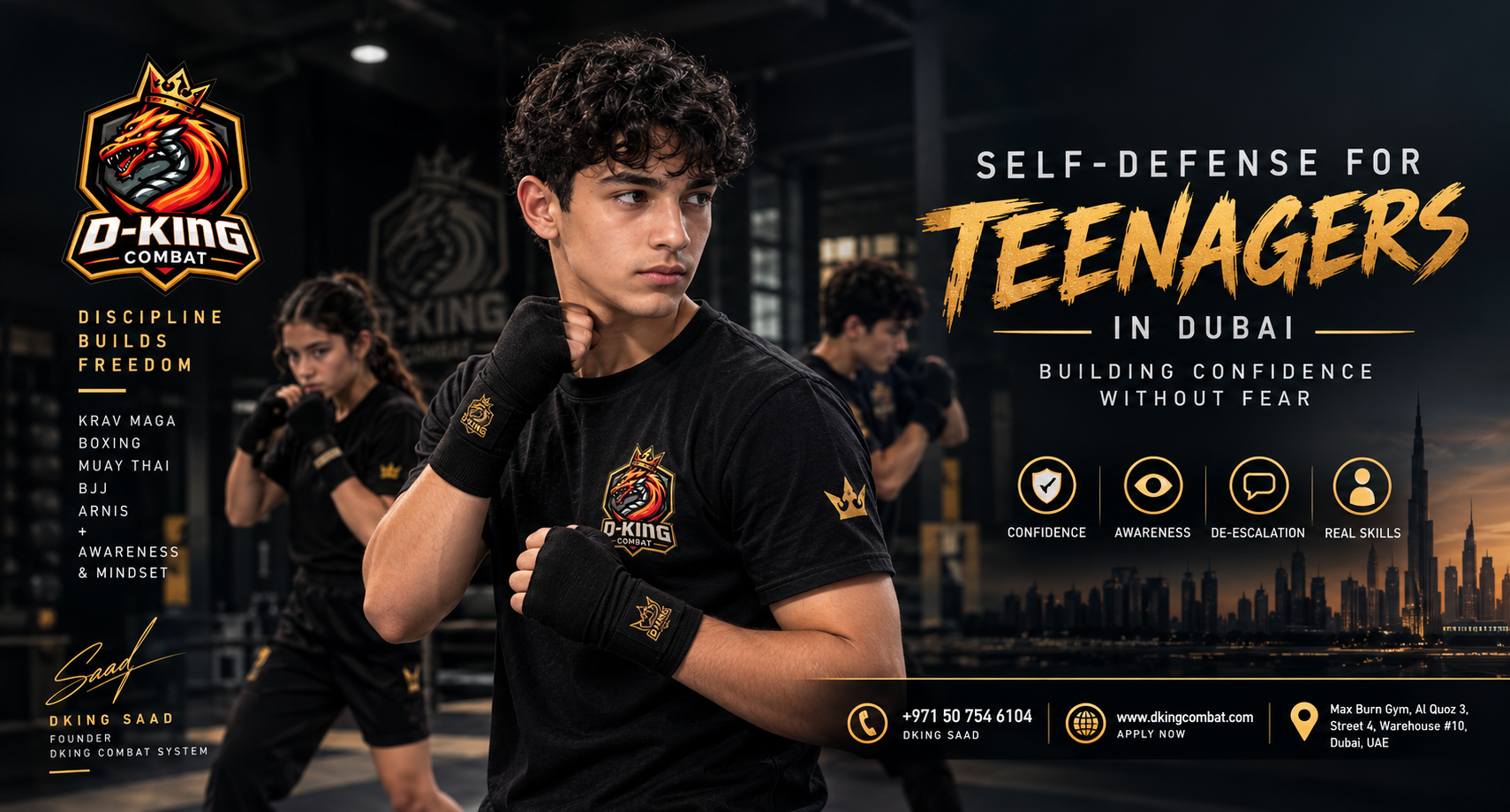
Self-defense training for teenagers in Dubai works best when it focuses on confidence, awareness, and de-escalation first, with physical technique as a last resort, not a fear-based sales pitch about danger. At DKing Combat in Al Quoz, teenage students train inside the same structured system as adults, scoped to their age and experience, building genuine composure for situations ranging from social pressure to a rare physical confrontation.
Why teenagers need a different approach than kids or adults
Teenagers are in a genuinely different position than younger kids or adults. They're navigating more independence, more complex social dynamics, and often their first real experiences with peer pressure, exclusion, or bullying, while still developing the judgment and emotional regulation that come with more life experience. Training built for this age group needs to reflect that, not a scaled-down adult class, and not a simplified kids' program, but something that actually speaks to what teenagers are dealing with.
The honest starting point: most of this isn't physical
The most useful skill for a teenager isn't a strike or an escape technique, it's the ability to read a situation, keep distance, and de-escalate before anything physical becomes necessary. This matters even more in social contexts like bullying, where the goal usually isn't winning a physical confrontation, it's recognizing an escalating situation early, setting a clear boundary, and knowing how to remove yourself from it. Physical technique matters as a genuine last resort, not the main event.
What this looks like in practice
Assertiveness and boundary-setting. Teenagers learn to communicate confidently and set clear boundaries, verbally and through body language, well before any physical response is relevant.
Situational awareness. Recognizing an uncomfortable or escalating situation early, trusting that instinct, and acting on it, whether that means leaving an area, telling a trusted adult, or simply removing themselves from a group dynamic that's turning unsafe.
De-escalation. Practical skills for defusing a tense confrontation with words and posture before it becomes physical, genuinely the most-used skill in real teenage social situations.
Physical fundamentals, when they're actually needed. Real, functional technique for the rare situation where physical response genuinely becomes necessary, taught seriously rather than as a confidence-boosting gimmick.
What we don't do
We don't sell teenagers, or their parents, the idea that a few classes make anyone untouchable. That's not honest, and it's not how real capability works. Confidence built on an exaggerated sense of physical invincibility is actually more dangerous than no training at all, since it can push a teenager toward a confrontation instead of away from one. Real training builds judgment alongside capability, not a false sense of certainty.
How training is structured for teenagers at DKing Combat
Teenage students train within the same DKing Combat System used across the academy, Krav Maga, Boxing, Muay Thai, BJJ, Arnis, and the system's Awareness Training and Mindset Development components, scoped specifically to age and experience level. Every student starts with an assessment, so a first-time teenage beginner is met at their actual starting point, not thrown into material built for adults with years of training behind them.
For parents considering this for their teenager
If you're a parent weighing this decision, the most useful question to ask isn't "will this make my teenager tough." It's whether the program builds genuine judgment, composure, and physical capability together, or whether it's selling confidence as a product without the substance behind it. That distinction matters more for teenagers than almost any other age group, since this is exactly the period where real judgment is still actively developing.
Frequently Asked Questions
Is self-defense training for teenagers fear-based?
It shouldn't be, and at DKing Combat it isn't. Training focuses on confidence, awareness, and de-escalation, treating physical technique as a genuine last resort rather than the main focus.
Does this training help with bullying specifically?
Yes, primarily through assertiveness, boundary-setting, and recognizing an escalating situation early, the skills that actually resolve most bullying situations before they become physical.
What age is appropriate to start this kind of training?
Programs are scoped to the individual student's age and experience level, assessed directly rather than applying one fixed age cutoff. Reach out to discuss what's appropriate for your teenager specifically.
Will this training make my teenager overconfident or aggressive?
Real training builds judgment alongside physical skill, not a false sense of invincibility. Programs that only build physical confidence without judgment can actually increase risk, which is why both are treated as equally important here.
How do I enroll my teenager in self-defense training in Dubai?
Apply through dkingcombat.com/apply or message DKing Saad directly on WhatsApp to discuss what's right for your teenager.
📍 DKing Combat System, Max Burn Gym, Al Quoz 3, Street 4, Warehouse #10, Dubai, UAE 📞 DKing Saad: +971 50 754 6104 🌐 dkingcombat.com ✅ Apply here: dkingcombat.com/apply
DKing Saad (Saad Iqbal) has coached martial arts and real-world self-defense for more than 20 years and is the founder of the DKing Combat System in Al Quoz, Dubai. More about Saad.