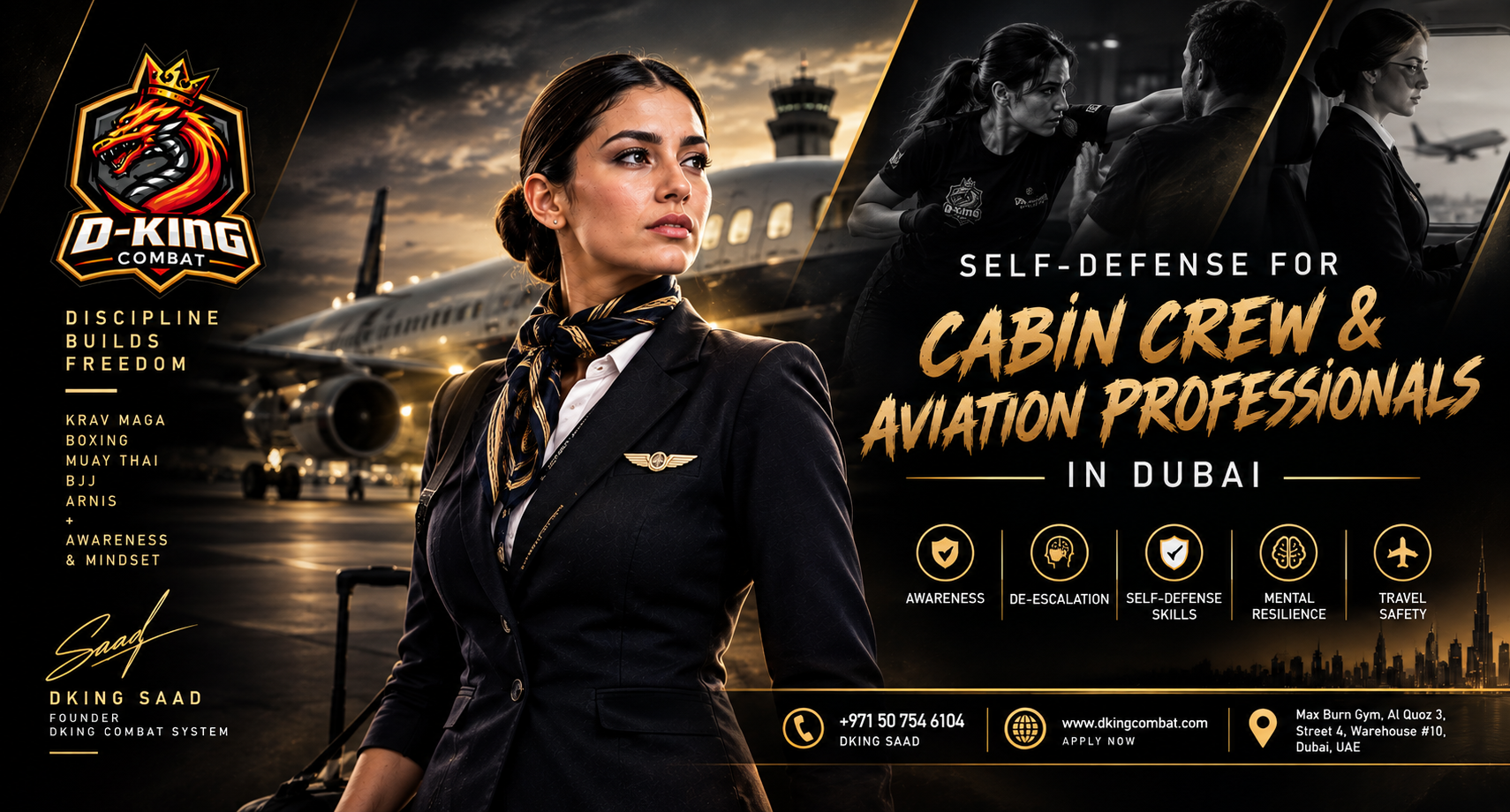
Quick Answer
Dubai is home to one of the world's largest aviation workforces, and cabin crew, pilots, and ground staff face a genuinely distinct set of safety considerations: unfamiliar layover cities, irregular hours, hotel stays, and, increasingly, managing unruly passenger behavior in the cabin itself. Awareness, de-escalation, and proportionate physical training are all relevant here, scoped to a working life that looks very different from a standard office job.
Why this profession is genuinely different
Aviation crew spend a significant portion of their working life outside their home city, in airports, hotels, and unfamiliar streets during layovers, often on schedules that don't match local daylight hours. On top of that, in-cabin incidents involving disruptive or aggressive passengers have become a documented, real trend across the industry in recent years, well-covered by aviation safety organizations and major airlines alike. None of this means aviation work is unusually dangerous. It means the role's structure, constant travel, irregular hours, and close-quarters passenger contact, creates a distinct risk profile worth addressing deliberately rather than assuming the same guidance that applies to a typical desk job.
Layover safety in unfamiliar cities
Research your layover city basics before you land. A few minutes understanding the general safety profile of the area around your hotel goes a long way, particularly for destinations you haven't visited before.
Use crew transport and licensed transport consistently. This is standard airline guidance for a reason, it removes a genuine point of vulnerability that solo, unfamiliar-city travel otherwise creates.
Stay aware during odd-hours arrivals. Landing and moving through an unfamiliar airport or city at 3 AM local time is a normal part of this job, and it's exactly when basic situational awareness, staying visible, moving with purpose, minimizing distraction, matters most.
Keep crew and colleagues informed of your movements. The same buddy-system logic that applies to any solo travel situation applies here, particularly during longer layovers with free time in an unfamiliar place.
Managing difficult in-cabin situations
Most cabin crew already receive company-mandated training in de-escalation and emergency procedures, and that training is the right first line of response, not a substitute we're suggesting here. What's worth adding to that foundation is genuine physical composure under pressure, the ability to stay calm, controlled, and effective if a situation in a confined space genuinely escalates beyond what verbal de-escalation resolves. This isn't about training to be aggressive with passengers. It's about the same principle behind all serious self-defense training: awareness and de-escalation first, physical response only as a last resort, and composure that holds up even in an unusually confined, high-stakes environment like an aircraft cabin.
Why aviation professionals benefit from this differently than most
A cabin, unlike most environments people train self-defense for, is enclosed, has limited exit options, and involves passengers you cannot simply walk away from. That's a genuinely unusual scenario, and it's worth training composure and control specifically with that context in mind, alongside the general fitness and stress-resilience benefits that apply to any demanding, irregular-hours profession.
How this fits into training at DKing Combat
Training for aviation professionals draws from the same Awareness Training, Pressure-Based Drills, and Mindset Development components used across the DKing Combat System, scoped to your actual schedule. Given the unpredictable rosters common in this industry, private sessions tend to fit far better than a fixed weekly group class slot.
Frequently Asked Questions
Is Dubai a risky base for aviation professionals?
No, the UAE consistently ranks among the safest countries in the world. This guidance addresses the specific structure of aviation work, layovers, odd hours, and confined-space passenger interactions, not a response to a common local threat.
Does self-defense training replace company crew safety training?
No. Company-mandated de-escalation and emergency procedures remain the primary response framework. Additional self-defense training builds physical composure and capability as a complementary layer, not a replacement.
What's the most useful safety habit during layovers?
Consistent use of licensed or crew-arranged transport, basic awareness of your layover city before arrival, and keeping colleagues informed of your movements during free time.
Can training fit around an irregular flight schedule?
Yes. Private sessions in particular can be scheduled around unpredictable rosters far more easily than a fixed weekly group class.
How do I start training as an aviation professional in Dubai?
Apply through dkingcombat.com/apply or message DKing Saad directly on WhatsApp to discuss a schedule that fits your roster.
📍 DKing Combat System, Max Burn Gym, Al Quoz 3, Street 4, Warehouse #10, Dubai, UAE 📞 DKing Saad: +971 50 754 6104 🌐 dkingcombat.com ✅ Apply here: dkingcombat.com/apply
DKing Saad (Saad Iqbal) has coached martial arts and real-world self-defense for more than 20 years and is the founder of the DKing Combat System in Al Quoz, Dubai. More about Saad.