Quick Answer
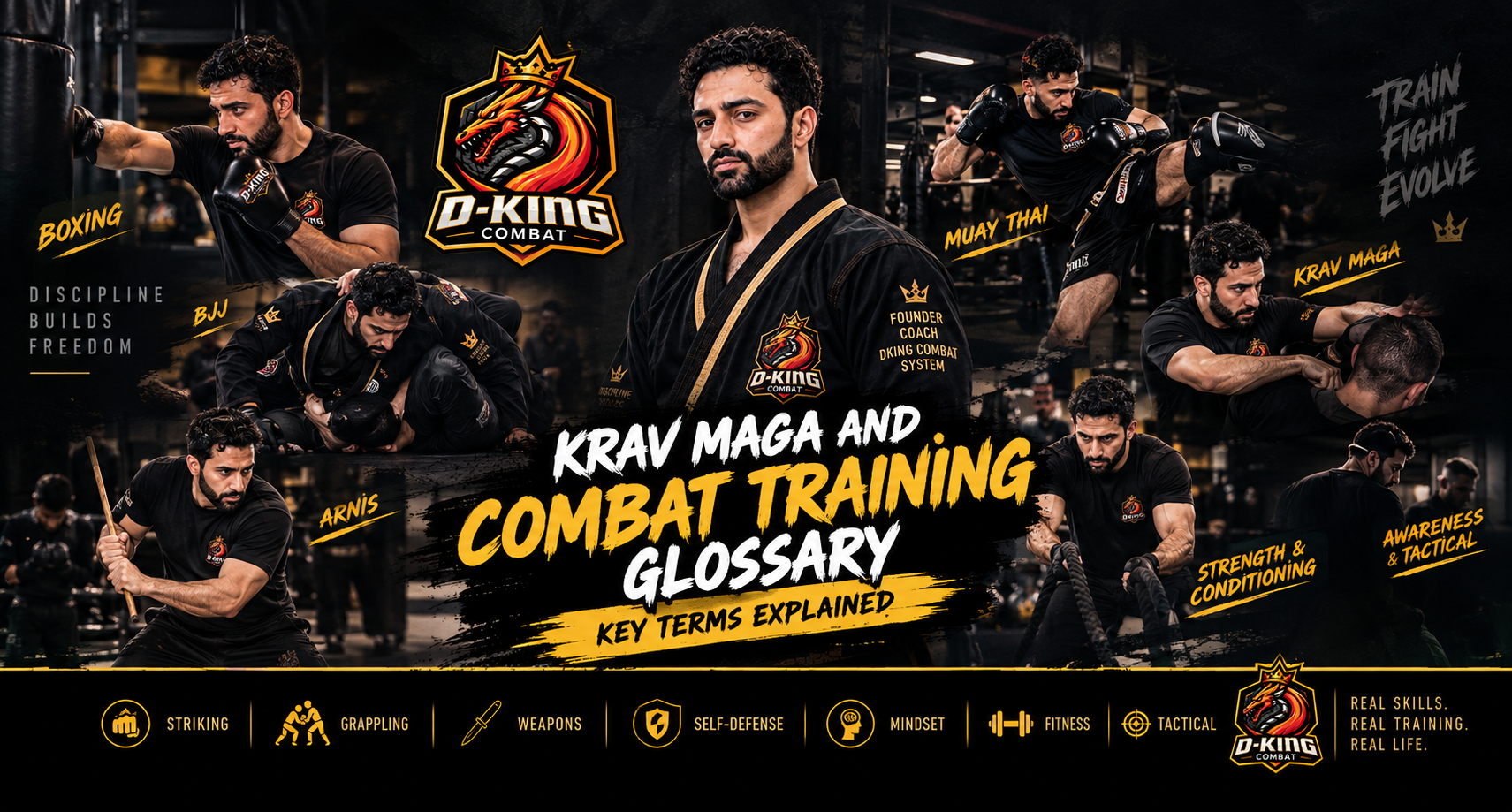
Combat training comes with its own vocabulary, and walking into a class without knowing the terms can make simple instructions feel confusing. This glossary covers the core terminology used across Krav Maga, boxing, BJJ, Muay Thai, and Arnis at DKing Combat, explained in plain language, not textbook definitions.
General Combat Terms
Adrenal stress training. Training designed to simulate the physical and mental effects of real adrenaline, elevated heart rate, tunnel vision, so technique holds up under genuine stress, not just in a calm drill.
CQB (Close Quarters Battle/Combat). Tactics and technique designed for very close-range confrontation, originally a military and law enforcement term, now applied broadly to close-range self-defense scenarios.
Gross motor skill. Large, simple movements (like a straight punch or a basic push) that remain reliable under stress, as opposed to fine motor skills, which tend to break down when adrenaline is high.
Pressure testing. Practicing technique against a partner who's genuinely resisting or reacting unpredictably, rather than a cooperative, scripted drill.
De-escalation. Verbal and behavioral techniques used to calm a tense situation before it becomes physical.
Striking Terms (Boxing, Muay Thai, Sanda)
Guard. The defensive hand and arm position used to protect the head and body while remaining ready to strike.
Clinch. Close-range grappling while standing, typically controlling an opponent's head, arms, or body to strike with knees or elbows, or to control their posture.
Combination (combo). A sequence of multiple strikes thrown together, rather than a single isolated punch or kick.
Footwork. The positioning and movement of your feet, which controls distance, balance, and your ability to strike or defend effectively.
Southpaw / Orthodox. Stances referring to which foot and hand lead, orthodox (right-handed lead) is more common; southpaw (left-handed lead) is the mirror stance.
Grappling Terms (BJJ, Wrestling)
Guard (BJJ-specific). A ground position where you control an opponent using your legs, often from your back, a defensive position that can also be used to attack.
Sprawl. A defensive movement against a takedown attempt, driving your hips down and legs back to avoid being taken to the ground.
Submission. A technique (a joint lock or choke) used to force an opponent to stop, typically by tapping out, before injury occurs.
Positional control. Maintaining a dominant position on the ground (such as mount or side control) rather than rushing toward a submission before control is established.
Takedown. A technique used to bring a standing opponent to the ground in a controlled way.
Krav Maga-Specific Terms
Simultaneous defense and attack. A core Krav Maga principle: defending against an attack and counter-attacking in the same motion, rather than defending first and attacking second.
Multiple attacker scenario. Training specifically focused on managing space, positioning, and threat prioritization when more than one attacker is involved.
Weapon disarm. A technique used to remove a weapon (knife, gun, blunt object) from an attacker's control.
Arnis/Filipino Martial Arts Terms
Angles of attack. The structured striking patterns used in Arnis, referring to the direction and trajectory of a strike with a stick or blade.
Mano Mano. The empty-hand application of Arnis principles, technique used without a weapon in hand.
Disarm. In Arnis specifically, a technique used to remove a stick or weapon from an opponent's grip during a live exchange.
Terms Specific to DKing Combat
Application-only. DKing Combat's enrollment model, every new student starts with an assessment rather than open, unrestricted sign-up.
The 14 components. The full structure of the DKing Combat System, Krav Maga, Boxing, Sanda/Wushu, Muay Thai, BJJ, Wrestling, Arnis, Combat Fitness, Strength & Conditioning, Awareness Training, Pressure-Based Drills, Mindset Development, Tactical Movement, and Real-Life Application.
Frequently Asked Questions
What does CQB mean in self-defense training?
Close Quarters Battle (or Combat), referring to tactics and technique designed for very close-range confrontation.
What's the difference between a submission and a takedown?
A takedown brings a standing opponent to the ground. A submission is a technique, typically a joint lock or choke, used once on the ground to end an exchange safely.
What is pressure testing, and why does it matter?
Practicing technique against a genuinely resisting partner rather than a scripted drill. It's what actually reveals whether a technique works under real conditions, not just in theory.
What does "application-only" mean at DKing Combat?
Every new student starts with an assessment rather than open enrollment, ensuring training fits both the student's goals and the structure of the group they're joining.
Where can I learn these terms in practice, not just definitions?
Apply through dkingcombat.com/apply or message DKing Saad directly on WhatsApp to start training.
📍 DKing Combat System, Max Burn Gym, Al Quoz 3, Street 4, Warehouse #10, Dubai, UAE 📞 DKing Saad: +971 50 754 6104 🌐 dkingcombat.com ✅ Apply here: dkingcombat.com/apply
DKing Saad (Saad Iqbal) has coached martial arts and real-world self-defense for more than 20 years and is the founder of the DKing Combat System in Al Quoz, Dubai. More about Saad.