Quick Answer
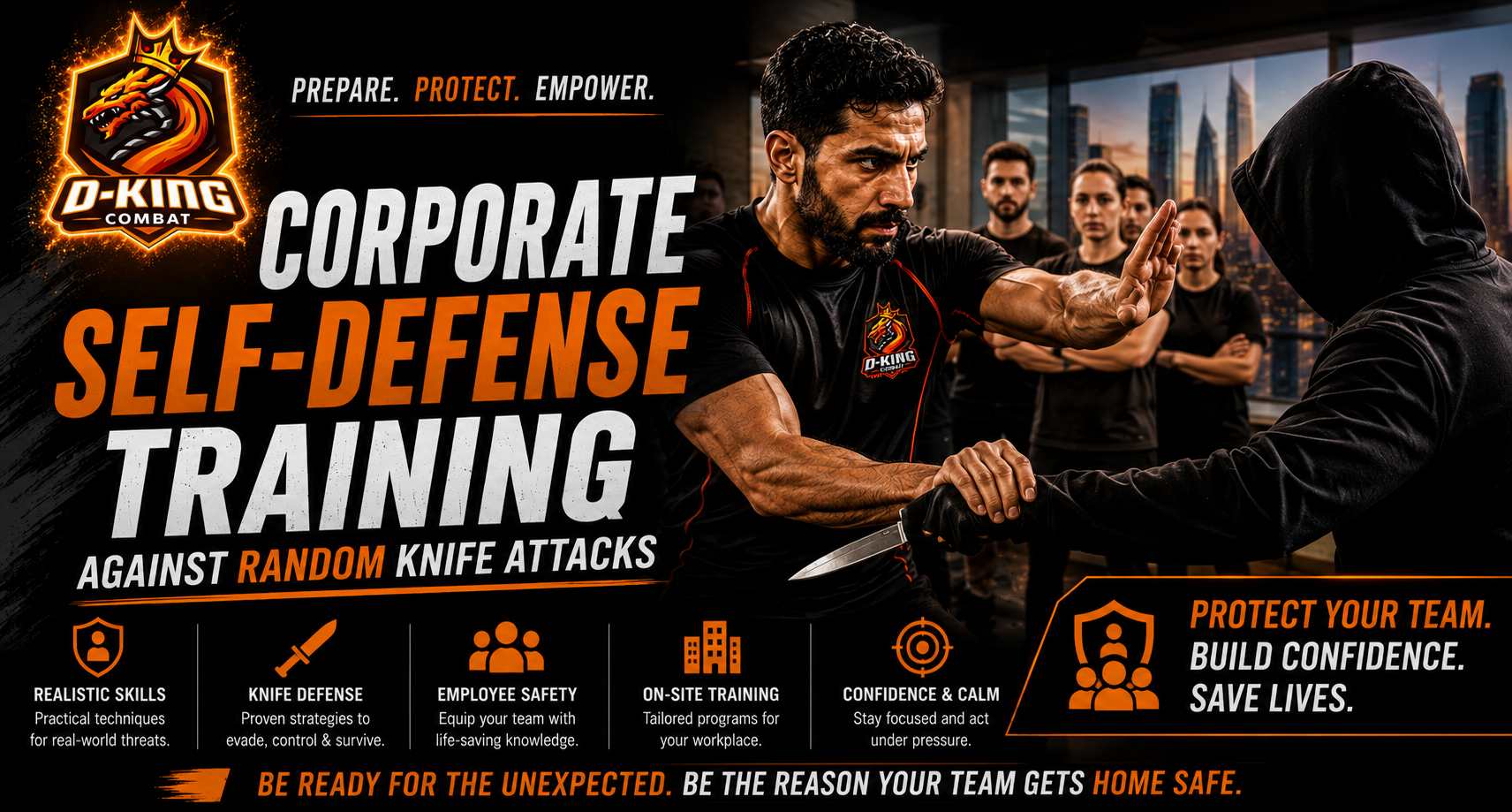
The UAE is one of the safest countries in the world, with one of the lowest crime indexes globally, and violent crime involving weapons is rare. That said, responsible corporate risk management still covers low-probability, high-consequence scenarios, the same logic behind fire drills and first-aid certification. DKing Combat's corporate training in Al Quoz, Dubai includes awareness-based preparedness for edged-weapon encounters, built around avoidance, distance, and de-escalation first, physical response only as a last resort, taught hands-on under proper supervision, never as something to learn from a document.
Let's be clear about the actual risk first
I want to say this plainly before anything else: the UAE, and Dubai specifically, has one of the lowest crime rates on earth. Independent safety indexes consistently rank it among the safest places in the world to live, work, and travel. Random knife violence is not a real, ongoing concern for people living and working here, and I'm not writing this to suggest otherwise.
So why does this training exist at all? Because responsible preparedness isn't based on how likely something is, it's based on how severe it would be if it happened, no matter how rare. Companies run fire drills despite fires being rare. They certify staff in first aid despite medical emergencies being uncommon in any given office. Preparedness for a genuinely worst-case, low-probability scenario is the same category of responsible planning, especially for companies whose staff travel internationally for work, where risk profiles differ from country to country.
Why this matters more for companies with traveling staff
If your team never leaves the UAE, this training is precautionary, the same as any drill. If your company has staff who travel for business, work in less predictable environments abroad, or handle roles with public-facing exposure, awareness training becomes more directly relevant, since it's covering the full range of environments your people actually operate in, not just the one they're safest in.
What this training actually focuses on
This is the part I want to be honest about. A blog post cannot, and should not, teach someone how to physically disarm an armed attacker. Real edged-weapon awareness training is about layers, most of which have nothing to do with physical technique:
Awareness first. Recognizing pre-attack indicators and agitated behavior before a situation escalates is worth more than any physical technique. Most violent encounters have observable warning signs beforehand.
Distance and avoidance. Creating space and removing yourself from a developing situation is almost always the correct first response, not standing your ground.
De-escalation. Verbal and behavioral de-escalation, staying calm, non-threatening body language, avoiding provocation, resolves far more tense situations than any physical skill does.
Environment as a tool. Using barriers, exits, and surroundings to create distance or escape is a core part of real training, and it's rarely what people picture when they imagine "self-defense."
Physical response as an absolute last resort. Only when avoidance and escape genuinely aren't possible does physical training become relevant, and that part is taught hands-on, in person, under direct supervision, at a pace matched to the student. It is never something we'd present as learnable from reading alone, and any program that claims otherwise isn't being honest with you.
How DKing Combat structures this for corporate teams
Corporate sessions are scoped to your team's actual exposure and risk profile, not a generic template. We start with an assessment conversation about what your staff actually encounter, office-based, client-facing, travel-heavy, and build the awareness and response training around that. This sits alongside our broader corporate self-defense training offering, and draws from the same DKing Combat System used in our individual and group programs, Krav Maga, Boxing, Muay Thai, BJJ, and Arnis/Eskrima, applied specifically to edged-weapon awareness scenarios.
If your company wants to talk through what a program like this would actually look like for your team, reach out through our contact page or message DKing Saad directly.
Frequently Asked Questions
Is knife violence a real concern in Dubai or the UAE?
No, not statistically. The UAE consistently ranks among the safest countries in the world, with a very low crime index and rare violent crime. This training exists as responsible precautionary preparedness, similar to fire drills, not because it reflects a real, common risk in the UAE.
Can you actually learn knife defense from a training session or article?
Awareness, avoidance, and de-escalation, which prevent the vast majority of situations from escalating, can absolutely be taught and practiced. Physical response techniques require hands-on, supervised, in-person training and should never be learned from written material alone.
Who should get this kind of corporate training?
Any company that takes duty of care seriously, especially those with staff who travel internationally, work client-facing roles, or operate in varied environments. It's precautionary planning, not a response to a specific threat.
Does this training fit into DKing Combat's regular programs?
Yes. It draws from the same DKing Combat System used across our individual, group, and corporate programs, scoped specifically to awareness and response for edged-weapon scenarios.
How do we set up corporate training with DKing Combat?
Contact us through our contact page or message DKing Saad directly on WhatsApp to discuss your team's size, roles, and what a scoped program would look like.
📍 DKing Combat System, Max Burn Gym, Al Quoz 3, Street 4, Warehouse #10, Dubai, UAE 📞 DKing Saad: +971 50 754 6104 🌐 dkingcombat.com ✅ Discuss a corporate program: dkingcombat.com/contact
DKing Saad (Saad Iqbal) has coached martial arts and real-world self-defense for more than 20 years and is the founder of the DKing Combat System in Al Quoz, Dubai. More about DKing Saad.